

Ecommerce Sales Funnel: Stages, Metrics, and How to Optimize It (2026)

The five stages, the content and tactics that move buyers through each, the metrics to track, and how to optimize for more sales.
Almost no one buys the first time they hear of a brand. They notice it, look it up, read a few reviews, compare alternatives, and only then come back to purchase.
That whole path, from first impression to loyal repeat buyer, is your e-commerce sales funnel. Map it well and you can guide shoppers through each step instead of hoping they find their own way.
Quality content and smart marketing matter at every stage, but they only pay off when they’re aimed at the right moment in the journey.
This guide breaks down the five funnel stages, the tactics that move buyers through each, the metrics to track, and how to optimize the whole thing for more sales.
What Is an Ecommerce Sales Funnel?
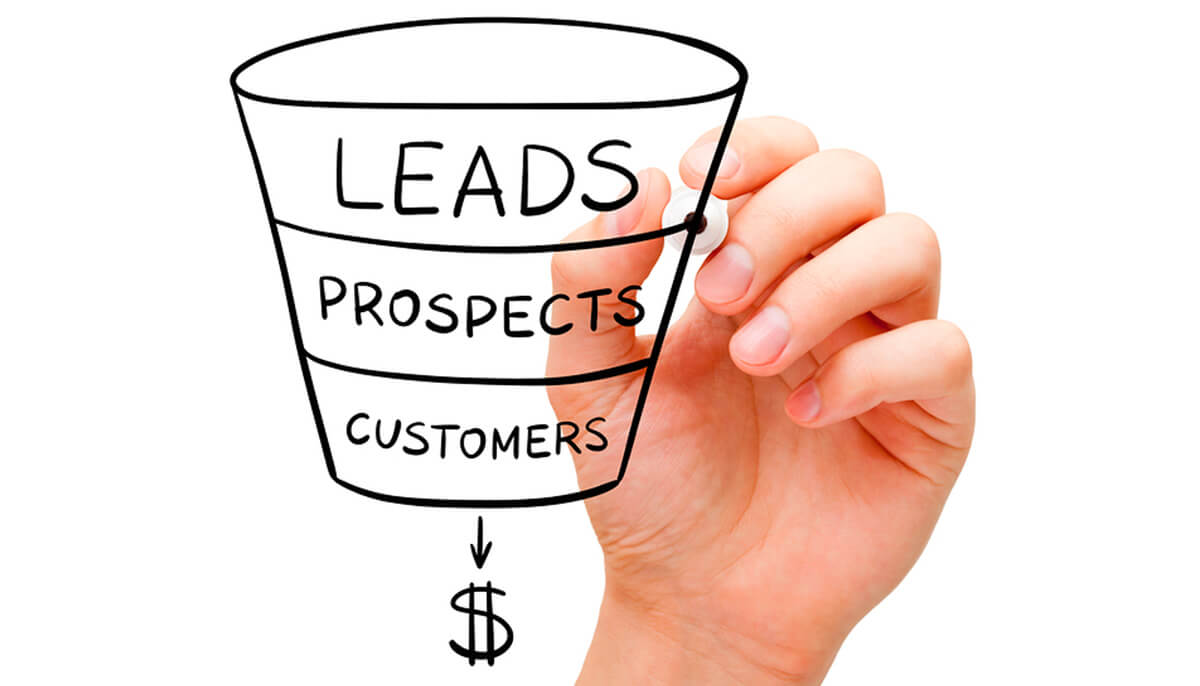
An e-commerce sales funnel is a visual model of the stages a customer moves through before (and after) buying from your store, from first becoming aware of your brand to becoming a loyal, repeat customer.
It’s called a funnel because the audience is widest at the top and narrows at each stage: many people hear about you, fewer consider you, fewer still buy, and a smaller core return again.
The concept dates back to 1898 and remains the backbone of digital marketing. The drop-off is steep, on average only around 3.3% of total website visitors reach the final purchase stage.
A defined funnel shows you exactly where shoppers fall away so you can fix it, rather than guessing why some campaigns work and others don’t. It also tells you what to say and when, so you can create highly-specific content for each moment in the journey instead of one-size-fits-all messaging.
Sales Funnel vs Marketing Funnel
The two overlap and people often use the terms interchangeably, but they aim at different end goals.
A marketing funnel is built to make people aware of your brand and nudge them to a first action, signing up for emails, creating an account, or landing on a product page.
A sales funnel has a single focus: turning those people into buyers and then repeat customers.
In practice they work together. Your marketing funnel draws people in and nurtures them until they’re ready to buy; your sales funnel takes it from there and carries the relationship through to loyalty. Treat them as one connected system rather than two separate efforts.
Why Your Store Needs a Funnel
Mapping the journey is what turns scattered marketing into a system. A well-built funnel delivers:
- Higher conversion rates. A cohesive path feels natural to shoppers, so more of them convert from the same traffic.
- Better customer retention. A funnel that continues past the purchase keeps buyers coming back, and retaining a customer is far cheaper than acquiring a new one.
- Clearer customer insight. You can see exactly where high-quality leads drop off and refine those steps.
- Higher average order value. Targeting shoppers at the right stage with cross-sells, upsells, and bundles lifts what they spend.
- Streamlined marketing. Every campaign has a clear job, moving prospects to the next stage, so you waste less budget on pushy or mistimed messaging.
The 5 Stages of the Ecommerce Sales Funnel
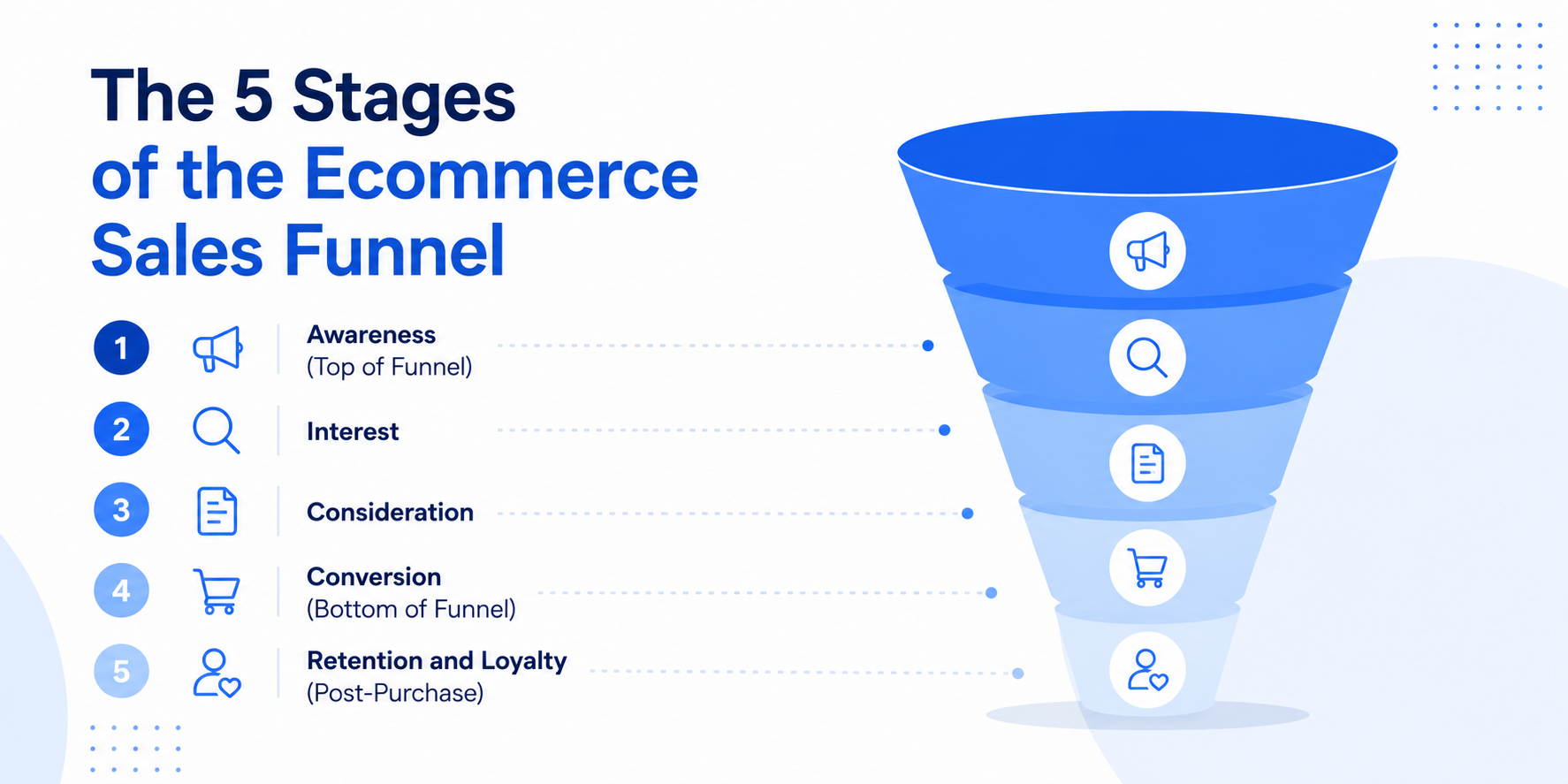
Funnels can be drawn with three to five stages, but the most complete model has five. Here’s each one, plus the content and tactics that work at that point.
1. Awareness (Top of Funnel)
The shopper has just discovered your brand, or realized they have a problem you can solve. Your job is to get noticed and earn initial interest with educational, valuable content, not a hard sell.
What works here: SEO and blog content, social media (organic and paid), search ads, influencer collaborations, video, infographics, and podcasts. To find what your audience is searching for, tools like Answer the Public, Soovle, or a keyword planner surface real queries to build content around.
2. Interest
The shopper now knows your brand and is actively seeking more information. The goal is to deepen curiosity and capture a way to keep in touch, an email signup, a follow, a quiz completion.
What works here: benefit-driven product pages, how-to guides, case studies, interactive content, and lead magnets like checklists or ebooks offered in exchange for an email. This middle-of-funnel stage is where you generate leads you can nurture toward a purchase.
3. Consideration
The shopper is comparing you against alternatives and looking for reassurance. Your job is to prove you’re the best choice and remove doubt.
What works here: detailed product pages with rich imagery and specs, honest comparison content, customer reviews and testimonials, demo and product videos, and clear return policies or guarantees. Social proof is decisive at this stage; the vast majority of shoppers read reviews before buying.

4. Conversion (Bottom of Funnel)
The shopper is ready to buy but may have a few last objections. The goal shifts from persuading to simply removing friction so they complete the purchase.
What works here: a streamlined, mobile-friendly checkout with guest checkout, transparent shipping and costs shown early, multiple payment options, security badges, time-sensitive offers, and abandoned-cart emails. Product descriptions, reviews, and well-timed emails are what tip the decision in your favor.
5. Retention and Loyalty (Post-Purchase)
The funnel doesn’t end at checkout. The most valuable customers repurchase, leave reviews, and refer friends, and reaching them is one of the highest-ROI activities you can run.
What works here: a great post-purchase experience (order confirmations, proactive shipping updates), loyalty programs, personalized email and SMS with relevant recommendations, review requests, and referral incentives. Keep delighting customers with useful content and they become brand advocates.
An Ecommerce Funnel Example
Here’s how a single shopper might move through all five stages:
- Awareness: they discover your store through a social media ad.
- Interest: they browse your collection and read a how-to guide on your blog.
- Consideration: they compare two of your products and read customer reviews.
- Conversion: a few days later, a 10%-off email nudges them to complete a purchase.
- Retention: a follow-up email invites them to a loyalty program and to leave a review.
The real journey is rarely this tidy, shoppers may bounce between stages or take dozens of touchpoints before buying, but the model still tells you what each touchpoint should accomplish.
Metrics to Track at Each Stage
You can’t improve what you don’t measure. These are the core funnel metrics, with rough industry benchmarks to compare against, though your own historical data is always the better yardstick.
| Stage | Key metrics | Rough benchmark |
| Awareness | Traffic, reach, click-through rate | Varies by channel |
| Interest | Bounce rate, pages per session, email opt-in rate | Email opt-in ~2%+ |
| Consideration | Product page views, add-to-cart rate, review engagement | Add-to-cart varies; product pages convert ~8% |
| Conversion | Overall conversion rate, cart abandonment rate, AOV | Site CVR <3%; cart abandonment ~70% |
| Retention | Customer lifetime value (CLV), repeat purchase rate, churn | Benchmark against your own data |
A few worth defining:
- conversion rate is purchases divided by visits;
- cart abandonment rate is how often shoppers add to cart but don’t check out (a high-leverage number to improve);
- average order value is total sales divided by orders;
- customer lifetime value is the total revenue a customer generates over the relationship. If even one of these is off, dig in, each points to a specific fixable problem.
How to Build and Optimize Your Funnel
Building an effective funnel comes down to a repeatable loop:
- Know your ideal customer and the problems they’re trying to solve.
- Create content for each stage so no step is left without the right message.
- Drive quality traffic with performance marketing and demand generation, untargeted traffic makes every downstream metric worse.
- Nurture with relevant content and personalized product recommendations.
- Optimize the checkout so buying is quick, transparent, and frictionless.
- Re-engage after purchase with email, loyalty programs, and review requests.
Then keep refining. Identify the stages with the highest drop-off, A/B test copy and layout rather than redesigning on a hunch, and use behavioral data to personalize offers.
Deliver a consistent, on-brand experience across every channel and stage to build trust. If this is more than your team can run alone, it can pay to hire an eCommerce marketing specialist who can align content and conversion work to each stage.
Where Multichannel Selling Fits
A funnel is only as strong as the traffic feeding it and the experience holding it together, and selling on more than one channel affects both.
At the top of the funnel, every marketplace you list on, Amazon, eBay, Etsy, alongside your own store, is another doorway shoppers can discover you through. More channels mean a wider awareness stage and more qualified traffic entering the funnel.
Further down, the risk is the opposite: inconsistent listings or out-of-stock items quietly break the funnel right when a shopper is ready to convert. A wrong price, a stale description, or an item that’s sold out on one channel but live on another costs you the sale.
This is where Sellbery fits, syncing your listings, inventory, and orders across Shopify, Amazon, eBay, Etsy, and WooCommerce from one place, so the experience stays consistent and accurate at every stage, on every channel.
FAQ
1. What are the stages of an ecommerce sales funnel?
The most complete model has five: awareness, interest, consideration, conversion, and retention. Some funnels compress these into three or four stages, but the underlying journey, from discovering a brand to becoming a loyal customer, stays the same.
2. What’s the difference between a sales funnel and a marketing funnel?
A marketing funnel aims to build awareness and prompt a first action, like an email signup or account creation. A sales funnel focuses on turning people into buyers and repeat customers. They work together: marketing feeds the funnel, sales converts and retains.
3. Which funnel stage is most important?
Every stage is connected, but retention often delivers the highest ROI because keeping an existing customer costs far less than acquiring a new one. The best approach is to optimize the whole funnel rather than fixating on one stage.
4. What metrics should I track for my ecommerce funnel?
At minimum: traffic, conversion rate, cart abandonment rate, average order value, and customer lifetime value. Track them by stage so you can see exactly where shoppers drop off and focus your fixes there.
5. How do I improve my funnel conversions?
Start by finding the stages with the highest drop-off, then test targeted fixes, clearer messaging, a smoother checkout, retargeting, and personalized offers, rather than redesigning everything at once. Most gains come from small, measurable changes.
Was this news helpful?
 Yes, great stuff!
 I’m not sure
 No, doesn’t relate