

The 2026 Customer Service Software Ranking: Chatbots, Self-Service, and How They Impact Satisfaction (CSAT)


Why high CSAT is the biggest driver of revenue in 2026—and the 10 tools that guarantee it. Discover the top customer service platforms for ROI.
Stop viewing customer service as a cost center. If you still see it that way in 2026, you are already losing market share.
The old model was simple: a customer has a problem, they complain, you fix it. That is reactive support. Today, that model is obsolete. By the time a customer has to ask you for help, friction has already occurred. Friction kills loyalty.
We need to talk about Service Intelligence. This is the shift from merely answering tickets to predicting needs and driving revenue. High Customer Satisfaction (CSAT) scores are no longer just vanity metrics for your support team to high-five over. They are direct proxies for Lifetime Value (LTV). A satisfied customer doesn’t just stay, but spend around 140% more than a dissatisfied one.
The software you choose to manage these interactions is critical. Modern success relies on speed, context, and stopping your business from bleeding revenue through churn.
Support is the New Sales: Why CSAT is Your Most Important Revenue Metric
Most business owners separate their “Support Brain” from their “Sales Brain.” This is a mistake.
In 2026, over 60% of support queries happen before or during a purchase. A question like “Do you have this in size M?” acts as a direct buying signal. If your software treats that question like a complaint to be filed in a queue, you lose the sale.
This brings us to the Self-Service Paradox. For years, brands feared that using bots would make them look “cheap” or “impersonal.” The data now proves the opposite. Modern customers (especially Gen Z and Alpha) prefer a smart bot that solves their issue in 10 seconds over a polite human who takes 10 minutes.
Correctly implemented self-service actually increases CSAT. It removes the wait time. It gives the customer control. And crucial for you: it frees up your expensive human talent to handle high-value negotiations and complex problem-solving, rather than resetting passwords.
The 2026 Ranking Criteria: Separating Hype from ROI
We didn’t build this list based on who has the flashiest website. We ranked these tools based on two factors that matter to business owners:
- Omnichannel Reality: Does it truly connect WhatsApp, Instagram, and Email into one stream? Or does it just pretend to?
- Revenue Impact: Does the tool help you sell? Does it reduce the Cost of Acquisition (CAC) by retaining customers?
Here are the platforms that survived the cut.
1. Kommo
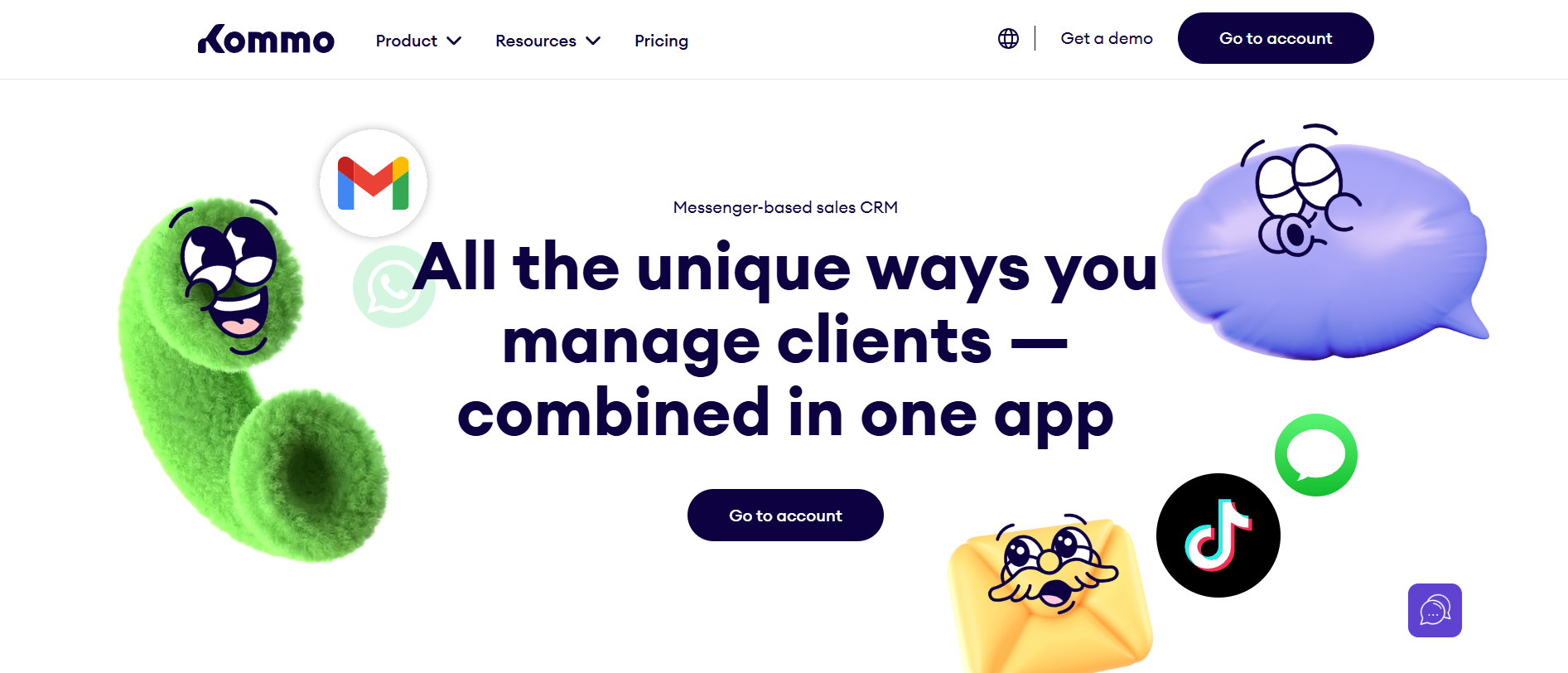
Kommo stands as one of the world’s first Conversational CRM, fundamentally reshaping how businesses handle customer interactions. While other platforms try to force legacy ticketing systems onto modern chat apps, Kommo was built natively for messaging.
If your business lives on WhatsApp, Instagram, or Facebook Messenger, this is your best option. Most support tools treat a chat message like a “ticket” with a random number. Kommo treats it like a “lead” in a pipeline. This subtle shift changes everything. It aligns your support team with your sales goals, ensuring that every resolved query moves the customer closer to a purchase.
Why it wins for entrepreneurs:
- Visual Pipeline: You can see exactly where every conversation stands—Open, In Progress, or Closed—using a Kanban board view that sales teams love.
- WhatsApp Native: It offers one of the most stable and feature-rich official WhatsApp Business API integrations available. You can automate replies, use templates, and broadcast messages without getting banned.
- Sales Focus: Unlike traditional helpdesks, Kommo empowers agents to create invoices and process sales directly inside the chat window.
- Collaboration: Agents can chat internally within a customer thread (invisible to the client) to solve issues faster without switching apps.
2. Intercom
Intercom set the standard for the little chat bubble in the bottom right corner of websites. Today, it has evolved into an AI-first customer service platform.
Their primary weapon is “Fin,” an AI agent that claims to resolve 50% of support queries instantly without human intervention. For SaaS companies or businesses with complex products requiring heavy customer education, Intercom is the benchmark. It excels at deflecting the “easy” questions so your team can focus on the hard ones.
Why it wins for SaaS:
- Fin AI Agent: It learns from your help center and answers questions with remarkable accuracy, reducing ticket volume overnight.
- Proactive Support: You can set up “tours” and pop-up messages to guide users before they get stuck.
- Ticket & Chat Hybrid: Seamlessly switches between live chat for urgent issues and email tickets for complex ones.
3. Zendesk
Zendesk is the industrial giant of the sector. If you are scaling past 50 agents or running a call center with complex routing needs, this is the safety pick.
Zendesk is less about “innovation” and more about “stability.” It connects to everything. It handles millions of tickets without crashing. You can measure everything from ‘average reply time by channel’ to ‘agent performance by time of day.’
Why it wins for scale:
- Granular Reporting: The analytics dashboard is unrivaled for managers who need deep data on team performance.
- Robust Ticketing: It handles email threads better than almost anyone else.
- Ecosystem: With thousands of apps in its marketplace, if you need to integrate with an obscure warehouse system, Zendesk probably has a plugin for it.
4. Gorgias
Gorgias has a singular focus: E-commerce. If you run a Shopify, BigCommerce, or Magento store, this is the engine you want.
General-purpose tools force your agents to keep two tabs open: the helpdesk and your store admin panel. Gorgias integrates them. When a customer asks “Where is my order?”, the agent sees the tracking number, order value, and shipping status right next to the chat. They can refund, cancel, or duplicate an order without leaving the screen.
Why it wins for E-commerce:
- One-Click Actions: Modify Shopify orders directly from the chat interface.
- Revenue Statistics: It tracks how much revenue your support team generates (e.g., from pre-sale chats), proving ROI.
- Social Comment Management: It pulls in comments from your Facebook and Instagram ads so you can reply to them as tickets.
5. HubSpot Service Hub
HubSpot Service Hub is the logical choice for businesses already locked into the HubSpot ecosystem.
The advantage here is the “Unified Customer View.” Because it sits on top of the HubSpot CRM, your support agent knows exactly which marketing emails the customer opened and which web pages they visited before complaining. This context prevents the annoying “Please explain your issue again” scenario that kills CSAT.
Why it wins for integration:
- Marketing & Support Sync: Support data informs marketing automation (e.g., “Don’t send a promo email if they have an open high-priority ticket”).
- Customer Portal: Allows customers to log in and view the status of their tickets securely.
- Knowledge Base: One of the easiest SEO-friendly help center builders on the market.
6. Freshdesk
Freshdesk (by Freshworks) is the answer for startups that need a professional system fast.
You can set up Freshdesk in an afternoon. It balances ease of use with power features. It’s a “meat and potatoes” ticketing system that just works.
Why it wins for speed:
- Gamification: Built-in mechanics to reward agents for fast resolution times, which can boost team morale.
- Freddy AI: Their AI assistant helps draft responses and summarize long ticket threads effectively.
- Rapid Deployment: Minimal configuration required to get email and chat support live.
7. Front
Front positions itself as the “anti-ticket” platform. It looks and feels like a regular email inbox (like Gmail or Outlook), but with superpowers.
This is ideal for B2B agencies, consultancies, or high-ticket service providers where relationships matter more than volume. Your clients hate getting an auto-reply that says “Your ticket #8492 has been received.” Front makes sure every email looks personal, even if multiple people are collaborating on it behind the scenes.
Why it wins for personal touch:
- Shared Inboxes: Manage team@ or info@ addresses collaboratively without forwarding emails.
- Internal Comments: Chat with your team directly on the email thread before replying to the client.
- No Ticket Numbers: Communication feels human and personal, preserving the relationship.
8. Tidio
Tidio focuses heavily on the intersection of support and marketing for small businesses.
It is famous for its “Lyro” AI, which is incredibly easy to set up. Tidio is less about managing complex support queues and more about turning website visitors into sales through quick answers. If you have a small team and high traffic, Tidio acts as a safety net to catch leads.
Why it wins for SMBs:
- Lyro AI: Can be trained on your FAQ in minutes and answers up to 70% of common questions.
- Live Typing: You can see what the visitor is typing before they hit send, allowing you to prepare the answer in advance.
- Cart Recovery: Automation flows to message customers who abandon their carts.
9. Zoho Desk
Zoho Desk creates massive value for technical teams on a budget.
Part of the sprawling Zoho ecosystem, Desk is highly customizable. If you have a developer on your team, you can make Zoho Desk do almost anything Zendesk does for a fraction of the price. It supports custom functions, complex workflows, and integrates well with other Zoho apps.
Why it wins for budget/customization:
- Context Aware: “Zia,” their AI, analyzes sentiment and tags tickets based on urgency.
- Multi-Department: Great for managing support across different brands or departments within one account.
- Cost Efficiency: Extremely competitive pricing for the feature set provided.
10. Salesforce Service Cloud
Salesforce Service Cloud is the nuclear option. It is powerful, complex, and capable of running global support operations for Fortune 500 companies.
For most small businesses, this is overkill. But for large enterprises with legacy databases, field service teams, and complex security requirements, Salesforce is the standard. It provides a complete 360-degree view of the customer, but expect a long implementation time.
Why it wins for enterprise:
- Field Service: Excellent integration for companies that have physical technicians (e.g., telecom, utilities).
- Scalability: Literally no limit to how big you can grow with it.
- AI (Einstein): Powerful predictive analytics, though it requires significant data to be effective.
Don’t Buy Features, Buy Integration
The biggest mistake entrepreneurs make in 2026 is buying a tool because of a “cool AI feature” they saw on LinkedIn.
AI is a commodity now. Everyone has it. The differentiator is Integration. Channel fragmentation is the enemy of CSAT. If your customer data is stuck in your email tool and doesn’t talk to your WhatsApp tool, your agents will be slow, your customers will be frustrated, and your churn rate will climb.
Audit your stack. Look at where your customers actually talk to you. If it’s email, use Front or Zendesk. If it’s chat and social media, use Kommo. Pick the tool that fits your reality, not the hype.
Was this news helpful?
 Yes, great stuff!
 I’m not sure
 No, doesn’t relate