


Best CookieYes Alternatives for 2026

5 CookieYes Alternatives for 2026: Compare Features and Pricing
Quick answer
CookieYes is still a good choice for smaller websites that mainly need a simple and affordable cookie consent solution.
But if you’re looking for an alternative, the best option depends on what you need:
- Enzuzo: Best for growing businesses that want cookie consent plus other privacy tools.
- iubenda: Best if you need cookie consent and legal documents in one place.
- Axeptio: Best if you want more control over the design and look of your cookie banner.
- Osano: Best for businesses with broader privacy and compliance needs.
- Ketch: Best for larger companies managing consent across websites, apps, and other systems.
If you only need a cookie banner, scanning, script blocking, and consent records, sticking with CookieYes may still be the simplest option (CookieYes cookie consent, September 2026).
Which CookieYes problem are you trying to solve?
| If you need… | Consider… | Why |
| Consent plus more privacy tools | Enzuzo | Combines consent management with privacy policies, DSAR workflows, reporting, and multi-domain support. |
| Consent and legal documents | iubenda | Offers cookie consent together with privacy policies, cookie policies, and terms and conditions. |
| A more branded consent experience | Axeptio | Gives you more control over banner design, customization, analytics, and visitor experience. |
| Broader privacy compliance | Osano | Includes privacy templates, compliance checks, subject rights support, and other privacy tools. |
| Consent across websites, apps, and systems | Ketch | Built to manage consent across different devices, channels, and connected systems. |
Simple cookie consent or a wider privacy platform?
CookieYes mainly focuses on cookie consent.
It gives you a customizable banner, cookie controls, automatic scanning, script blocking, consent records, a consent withdrawal widget, and Google Consent Mode support.
It also supports more than 30 languages and works with both CMS-based and custom HTML websites. (CookieYes cookie consent, September 2026)
The alternatives on this list go in slightly different directions.
Enzuzo and iubenda add more privacy tools and documents. Axeptio stays focused on consent but gives businesses more control over design and user experience. Osano and Ketch go further, offering tools for larger privacy and compliance needs.
That doesn’t mean the platform with the most features is automatically the best.
If you run a small website, CookieYes or iubenda may give you everything you need. A larger company with more complicated privacy requirements may get more value from Osano or Ketch.
1. Enzuzo
Enzuzo sits somewhere between a simple cookie banner and a large privacy management platform.
It can be a good fit for businesses that have grown beyond basic cookie consent but don’t need a complicated enterprise solution.
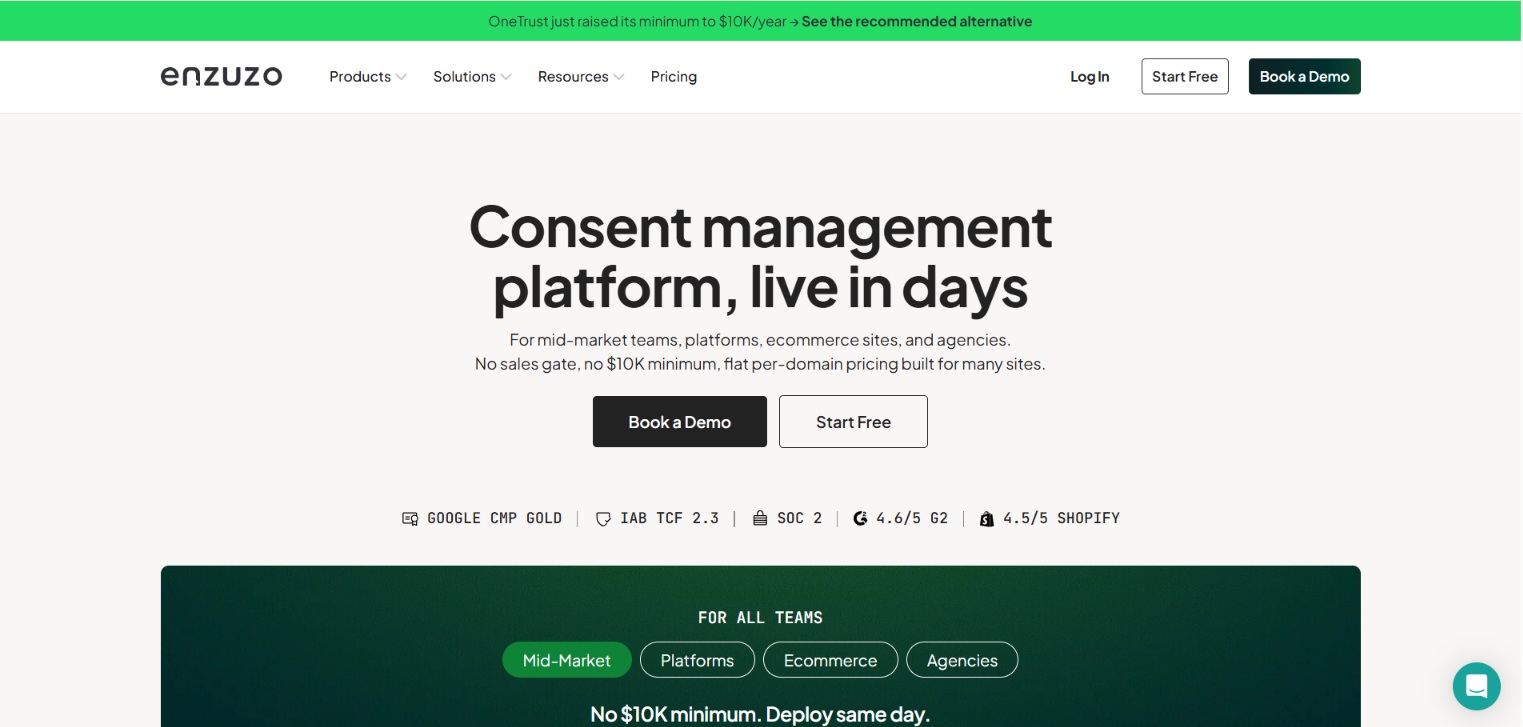
Its consent features include cookie and tracker scanning, consent banners, consent logs, Google Consent Mode v2, IAB TCF 2.3, Microsoft UET support, geo-specific blocking, multiple languages, compliance monitoring, APIs, and webhooks (Enzuzo consent management, September 2026).
You also get other privacy tools, including privacy policies, terms of service, DSAR workflows, DSAR reporting, and compliance health features. The exact tools available depend on your plan (Enzuzo pricing, September 2026).
Enzuzo has a free plan, while paid plans start at $9 per month. Starter supports one domain and 5,000 monthly visitors. Growth supports four domains and 10,000 visitors, while Pro supports ten domains and 30,000 visitors.
Annual plans are available at a discount (Enzuzo pricing, September 2026).
Why choose Enzuzo over CookieYes?
Enzuzo makes sense if you need more than cookie consent.
For example, instead of using separate tools for your cookie banner, privacy policies, and DSAR requests, you can handle these from one platform.
It can also be useful if you manage several websites, as the higher plans support multiple domains.
When CookieYes may be enough
If you only need an affordable cookie banner for a small website, there may not be much reason to switch.
Enzuzo’s extra privacy features are useful, but you don’t necessarily need them if your only goal is managing cookies and consent.
So, Enzuzo is best seen as a broader option for businesses that expect their privacy needs to grow.
2. iubenda
iubenda is worth considering if you want to manage cookie consent and legal documents in the same place.
Its cookie solution scans your website for cookies, pixels, and trackers. It can block them before consent, save visitors’ choices, and change consent settings based on location (iubenda cookie solution, September 2026).
It also supports Google Consent Mode v2, the IAB Transparency and Consent Framework, APIs, mobile SDKs, and different integrations (iubenda cookie solution, September 2026).
One of iubenda’s biggest differences from CookieYes is its legal document tools.
You can use the platform to create privacy and cookie policies, terms and conditions, and other documents. Higher plans also include more languages, geo-targeting, additional legal clauses, analytics, and more detailed data management guidance.
Paid pricing starts at €4.99 per month with annual billing. Plans include 25,000, 50,000, or 150,000 monthly pageviews. Additional pageviews cost €0.05 per 1,000 (iubenda pricing, September 2026).
Why choose iubenda over CookieYes?
The main reason is simple: legal documents.
If you need both cookie consent and privacy documentation, iubenda lets you manage them from the same dashboard instead of using CookieYes together with another policy generator.
What to keep in mind
iubenda charges based on sites and pageview allowances (iubenda pricing, September 2026).
That works well for one or two websites, but your costs can increase as you add more sites or go above the included pageviews.
It also puts more focus on legal documents than CookieYes or Axeptio. So, if your main priority is creating a highly customized cookie banner, another option may suit you better.
3. Axeptio
Axeptio takes a slightly different approach.
Instead of treating the cookie banner as just another compliance pop-up, it puts more attention on how consent fits into the overall customer experience (Axeptio website, September 2026).
You can customize visuals, videos, motion design, fonts, colors, logos, buttons, banner positions, and even the tone of voice. Axeptio also includes consent analytics, A/B testing, vendor management, a mobile SDK, and more than 1,500 pre-integrated vendors (Axeptio website, September 2026).
Depending on the plan, you can also get Google Consent Mode v2, TCF support, statistics, analytics connectors, a Consent Wall, cookie lists, and website scanning.
There is a free plan covering up to 2,500 pageviews per year. Paid tiers support up to 5,000, 100,000, or 500,000 monthly pageviews. Lower plans are limited to one domain (Axeptio pricing, September 2026).
Why choose Axeptio over CookieYes?
Axeptio stands out if you care about how your cookie banner looks and feels.
You have more freedom to make the consent experience match your brand instead of using a standard-looking cookie banner.
It also supports mobile app consent for both iOS and Android (Axeptio website, September 2026).
What to keep in mind
Axeptio is still mainly focused on consent management.
If you’re looking for DSAR management, privacy policy generation, data mapping, or a complete privacy management system, it may not be the best fit.
Its domain and pageview limits can also make it less practical for agencies managing many client websites (Axeptio pricing, September 2026).
4. Osano
Osano goes beyond basic cookie consent.
It’s designed for companies that want cookie management to be part of a larger privacy and compliance setup.
Its free plan includes one user, one domain, and up to 5,000 monthly visitors.
The Small Businesses plan costs $199 per month and includes two users, three domains, 30,000 monthly visitors, privacy and legal templates, and a UK and GDPR representative (Osano pricing, September 2026).
Osano also offers a custom plan with unlimited users and domains, compliance checks, subject rights workflows, onboarding, and additional support.
Its No Fines Guarantee can cover eligible regulatory fines of up to $500,000, based on Osano’s terms (Osano pricing, September 2026).
Why choose Osano over CookieYes?
Osano makes more sense if cookies are only one part of your privacy work.
For example, you may also need privacy templates, compliance monitoring, subject rights management, or regulatory support (Osano pricing, September 2026).
That makes it more useful for companies with a dedicated privacy team or more complicated compliance requirements.
What to keep in mind
The biggest difference is price.
Osano’s paid plan starts at $199 per month, which is much higher than CookieYes plans starting at $10 or $25 per month (Osano pricing, September 2026; CookieYes pricing, September 2026).
If you only need a cookie banner and basic consent management, paying that much probably won’t make sense.
Some of Osano’s more advanced tools also use custom pricing, so you may need to contact the company to understand the full cost (Osano pricing, September 2026).
5. Ketch
Ketch is probably the least direct CookieYes alternative on this list.
It’s designed for larger organizations that need to manage consent across websites, mobile apps, different brands, users, and connected business systems (Ketch consent management, September 2026).
The platform offers individual consent records, continuous tag scanning, HAR file analysis, consent management, and native SDKs for iOS, Android, and React.
It also connects with marketing, analytics, CRM, CDP, and other data platforms (Ketch consent management, September 2026).
Other features include banners, modals, policy templates, age gating, Do Not Sell controls, and identity-aware consent.
Ketch has a free plan for up to 5,000 unique users and two integrations.
The Starter plan costs $150 per month for up to 30,000 unique users. Plus starts at $499 per month when billed annually and supports up to 100,000 unique users. Larger businesses can choose an Enterprise plan (Ketch pricing, September 2026).
Why choose Ketch over CookieYes?
Ketch is useful when consent needs to work across more than your website.
For example, you may need someone’s privacy choices to be respected across your website, mobile app, CRM, advertising tools, and other data platforms (Ketch consent management, September 2026).
That’s a much bigger job than simply adding a cookie banner to a website.
What to keep in mind
For most small businesses, Ketch will probably be more than they need.
Its paid plans are much more expensive than CookieYes, and many of its features are designed for businesses with complicated privacy and technology setups.
If you only need cookie scanning, blocking, consent records, and a banner, a simpler platform will likely make more sense.
How does the pricing compare?
Comparing these tools based only on price isn’t easy because they don’t all charge in the same way.
CookieYes charges per domain and uses pageview and scan limits. Its free plan includes 5,000 monthly pageviews and scans of up to 100 pages (CookieYes pricing, September 2026).
Enzuzo uses domain and monthly visitor limits, while iubenda charges per site and includes a set number of pageviews. Axeptio also uses domain and pageview limits, with different features depending on the plan (Enzuzo pricing, September 2026; iubenda pricing, September 2026; Axeptio pricing, September 2026).
Osano and Ketch are much more expensive, but they’re also built for broader privacy needs.
Osano’s paid plan starts at $199 per month. Ketch starts at $150 per month, with its higher published plan starting at $499 per month (Osano pricing, September 2026; Ketch pricing, September 2026).
So, don’t look at price alone.
CookieYes may offer better value if you only manage one small website. But paying more for another platform can make sense if it replaces several tools or helps you manage multiple domains, legal documents, DSAR requests, or consent across different systems.
The bottom line
CookieYes is still a good choice for small websites that need simple and affordable cookie consent.
If you need more, the right alternative depends on what’s missing.
Enzuzo is a good all-around option for growing businesses. iubenda makes sense if you also need legal documents. Axeptio is better if you care about creating a branded consent experience. Osano is designed for broader privacy and compliance needs, while Ketch is built for more complex setups across websites, apps, and other systems.
And if CookieYes already gives you everything you need, there may be no reason to switch.
The best alternative isn’t the one with the most features. It’s the one that solves the problems your current setup doesn’t.
Frequently Asked Questions
1. Do I need a cookie consent tool for every website?
It depends on the cookies you use and the privacy laws that apply to your visitors.
2. Can I switch from CookieYes to another platform easily?
Usually, yes. You’ll typically need to remove the old setup, install the new one, and configure your consent settings again.
3. Do cookie consent tools automatically block cookies?
Many do, but the way blocking works varies by platform and setup. Always check what is included in your plan.
4. Can these tools work with Google Analytics?
Most modern consent platforms can work with Google Analytics and Google Consent Mode, though setup requirements vary.
5. Will a cookie banner slow down my website?
It can add some extra code, but a properly configured consent tool should have a limited impact on site performance.
6. Can I customize the text on my cookie banner?
Generally, yes. Most platforms let you change the banner text, buttons, and basic settings, while some offer much more design control.
7. Do I still need a privacy policy if I use a cookie consent tool?
Yes. A cookie banner and a privacy policy serve different purposes, so using a consent tool doesn’t normally replace the need for a privacy policy.
Was this news helpful?
 Yes, great stuff!
 I’m not sure
 No, doesn’t relate