



Ad Monetization for Marketplace Apps

Ad Monetization for Marketplace Apps
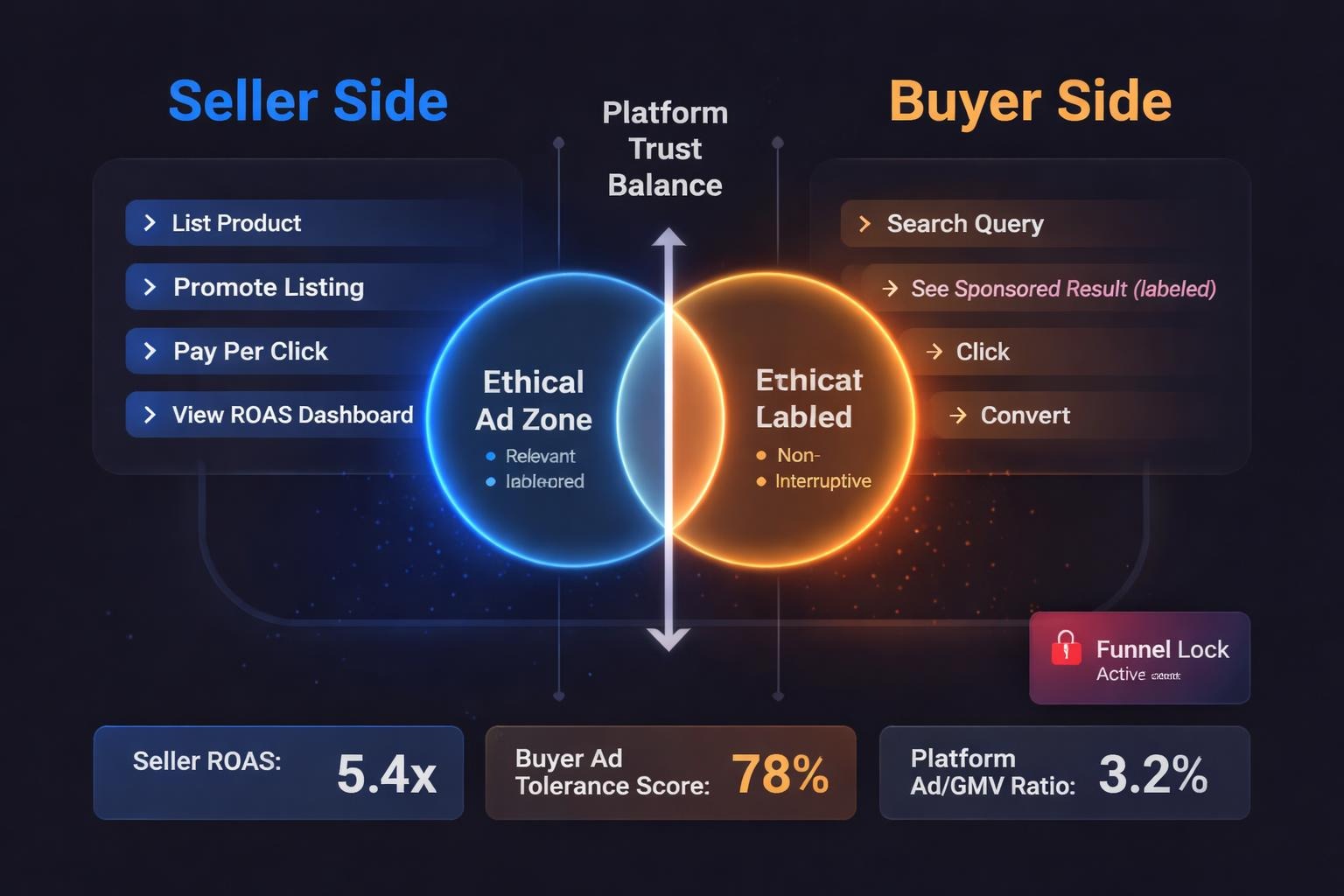
Most marketplace app developers face a paradox that eCommerce or gaming developers never encounter: you have two distinct user groups with fundamentally different relationships to your platform, and a single poorly placed ad can damage trust with both simultaneously. A buyer who sees a promoted listing from an irrelevant seller loses confidence in your search algorithm. A seller who pays for visibility and gets zero qualified clicks loses confidence in your ad product. You lose both.
This guide is written for the developer or product lead at a marketplace company — whether you’re building a vertical marketplace for handmade goods, a B2B procurement platform, or a consumer-to-consumer resale app — who understands that ad monetization is not a layer you bolt on top of your product. It is a product decision with direct consequences for GMV, retention, and platform health.
The opportunity is real. In-app advertising within marketplace platforms is projected to become a dominant revenue stream across the industry, driven by the same logic that turned Amazon’s advertising business into a $47B division. But the execution gap between platforms that do this well and platforms that destroy seller trust and buyer experience in the process is enormous. Let’s close that gap.
The Psychology of Marketplace Ads — Why Context Changes Everything
Interruption vs. Relevance
In a gaming context, the central tension in ad monetization is between interruption and reward. In a marketplace context, the tension is different: it’s between relevance and manipulation. A buyer browsing your platform has a goal. They are looking for something specific. Every ad format you deploy is either helping them find it faster, or it is visibly prioritizing your revenue over their outcome.
This distinction matters because marketplace users are cognitively different from passive entertainment consumers. They are in task mode. Cognitive load is already high — they are comparing prices, evaluating sellers, reading reviews. An ad that feels irrelevant in this state doesn’t just get ignored. It registers as a signal that your platform’s results cannot be trusted.
Sponsored Listings: The Marketplace’s Rewarded Video
The most important insight in marketplace ad psychology is that Sponsored Listings are the structural equivalent of Rewarded Video in gaming. The mechanic is identical: a value exchange where all parties benefit. The seller pays for premium visibility. The buyer receives a highly relevant result surfaced earlier in their search. The platform earns revenue without degrading the organic experience.
This works because the ad is the content. A Sponsored Listing in a search results page for “handmade ceramic mugs” is not interrupting the user’s task — it is participating in it, provided the listing is genuinely relevant. The moment relevance breaks down — when a ceramic mug search surfaces a sponsored result for a coffee machine — the entire mechanic collapses and buyer trust degrades rapidly.
Best Practice for Sponsored Listings: Enforce strict category-level relevance matching for all promoted results. Never allow a seller to buy visibility outside their primary product category. The short-term revenue from category-agnostic bidding is not worth the long-term damage to search quality perception.
Pro-Tip: Run a quarterly “Trust Audit” on your sponsored results. Pull a sample of 500 Sponsored Listing impressions and manually score relevance on a 1–5 scale. If your average relevance score drops below 3.5, your ad product is actively damaging your platform’s core value proposition — regardless of what your ad revenue dashboard shows.
The Metrics That Matter for Two-Sided Platforms
Standard ad metrics exist in a gaming or publisher context. Marketplace platforms require an expanded framework that accounts for both sides of the transaction.
eCPM — Reframed for Marketplace


In a marketplace context, eCPM is your supply-side efficiency metric. A healthy Sponsored Listing eCPM for a mid-size consumer marketplace typically ranges between $8 and $22, depending on category competitiveness and audience quality. However, eCPM in isolation is a dangerous metric for marketplace operators because it can be artificially inflated by reducing ad inventory supply — which simply means fewer sellers get promoted, reducing your platform’s overall competitiveness.
Seller Ad ROI — The Metric Your Sellers Actually Care About

This is the most important metric for the seller side of your platform. If sellers cannot see a clear, credible ROI from their ad spend, your promoted listing product will churn regardless of how sophisticated your targeting infrastructure is. Platforms that expose transparent Seller Ad ROI dashboards — showing attributed clicks, attributed orders, and cost-per-acquisition — retain advertiser spend at significantly higher rates than those that only show impression counts.
Best Practice: Build a minimum viable Seller Ad Dashboard before you launch your promoted listings product. It must show at least: impressions, clicks, CTR, attributed conversions, total spend, and ROAS. Sellers who can see their ROI spend more. Sellers who are flying blind churn.
Buyer Ad Tolerance Score
This is a composite behavioral metric you construct internally, not a standard industry figure:

A high score indicates buyers are engaging with promoted content without immediately bouncing or refining their search to escape ad-heavy results pages. A declining score is an early warning signal that your ad density or relevance is degrading buyer experience before it shows up in retention or GMV data.
ARPDAU for Marketplace Apps

For marketplace apps, ARPDAU from advertising should be tracked separately from ARPDAU from transaction fees and commissions. Blending these figures obscures the true performance of your ad product. A healthy two-sided marketplace with an active promoted listings program should target ad-specific ARPDAU between $0.03 and $0.09, scaling with category depth and seller competition.
Platform LTV — The Full Equation

For marketplace platforms, ARPUARPU ARPU must account for both buyer-side revenue (transaction fees, subscription tiers) and seller-side revenue (listing fees, ad spend, commission). Optimizing ad revenue at the expense of either side’s lifespan collapses this equation from both directions simultaneously — which is why aggressive ad monetization without relevance controls is an existential risk, not just a UX problem.
Pro-Tip: Model your LTV equation with three separate user cohorts: buyers only, sellers only, and dual-role users (people who both buy and sell on your platform). Dual-role users almost always have the highest LTV and the highest ad tolerance. Design your ad product to serve them first.
Platform-Specific Rules for Ad Integration
Ad Fatigue in a Marketplace Context
Ad fatigue in marketplace apps manifests differently than in gaming. It rarely shows up as a session abandonment event. Instead, it appears as search behavior degradation: users begin adding more specific filters, using longer search queries, or switching directly to seller profile browsing — all behavioral signals that indicate a loss of trust in your top-level search results.
Monitor average search query length as a proxy metric for ad fatigue. A statistically significant increase in query length among heavy-session users correlates strongly with over-promoted search result pages.
Frequency Capping for Marketplace Ads
Unlike gaming, where frequency capping is primarily about session-level ad exposure, marketplace frequency capping must operate at the seller level and the category level, not just the format level.
Practical rules that protect buyer experience without gutting seller revenue:
A single seller’s Sponsored Listing should not appear more than twice on the same search results page, regardless of their bid level. Promoted listings from the same parent category should not occupy more than 30% of any results page — this preserves the integrity of organic results and prevents the perception that your platform is “pay to win.” Push notification ads, if used, should be capped at a maximum of two per week per user, and should only fire when the content is directly tied to a category the user has browsed in the past 7 days.
Best Practice for Interstitial-Style Formats: If you use full-screen ad formats — such as interstitials shown during app open or category transitions — restrict these exclusively to moments where the user has no active search intent. App open, post-purchase confirmation screens, and post-review submission screens are acceptable. Mid-search, mid-browse, and mid-checkout are never acceptable contexts for interruptive formats.
The Purchase Funnel is Sacred
The single most important anti-churn rule for marketplace monetization: never show a competitor’s advertisement to a user who is inside a purchase funnel. A user who has added an item to their cart, begun checkout, or opened a product detail page with high dwell time is in a high-intent conversion state. Showing them a competing Sponsored Listing at this moment does not generate incremental ad revenue — it generates cart abandonment and seller complaints simultaneously.
Implement a “funnel lock” in your ad serving logic: once a user has triggered a high-intent signal (add to cart, checkout initiation, product detail page dwell time exceeding 45 seconds), suppress all competing promoted listings until the session resolves.
Pro-Tip: A/B test your funnel lock implementation with a 30-day holdout group. Measure not just conversion rate, but seller-reported satisfaction scores in the following billing cycle. The revenue you appear to “lose” by suppressing ads in the funnel is almost always recovered in improved conversion rates and seller retention.
Building Your Marketplace Ad Stack
In-House vs. Programmatic: A Different Decision Than Gaming
Gaming developers default to third-party mediation because they lack advertiser relationships. Marketplace developers have a structural advantage: your sellers are your advertisers. This means the build-vs-buy decision for your ad stack is genuinely complex and depends on your platform’s scale.
Below 10,000 monthly active sellers: Use a third-party promoted listings infrastructure provider (Kevel, Monetate, or a white-label solution) rather than building in-house. The engineering cost of a custom ad server at this scale is not justified.
Between 10,000 and 100,000 monthly active sellers: A hybrid approach works well — in-house Sponsored Listings product for your core inventory, with programmatic display (Google AdManager or Amazon Publisher Services) filling secondary placements such as category pages and editorial content sections.
Above 100,000 monthly active sellers: You have the data density and advertiser base to justify building a proprietary Retail Media Network — a closed-loop ad system where your first-party transaction data powers targeting, attribution, and optimization. This is the Walmart Connect / Target Roundel model, and it commands eCPMs 3–5x higher than comparable open-market programmatic inventory because the purchase-intent signal is unmatched.
A/B Testing Ad Placements — Marketplace-Specific Variables
The variables worth testing in a marketplace context go beyond simple placement position. Test the label transparency of your sponsored results — platforms that clearly label promoted listings as “Sponsored” outperform those that obscure the label in long-term buyer trust metrics, even if the unlabeled version shows marginally higher short-term CTR. Test the density ratio of sponsored to organic results: 1:4 (one promoted per four organic) vs. 1:6 vs. 1:8. Most platforms find that 1:5 or 1:6 maximizes the product of ad revenue and search satisfaction simultaneously.
Pro-Tip: Never A/B test ad placements during peak commerce seasons (holidays, major sale events). User behavior during these periods is anomalous and will produce misleading results. Run placement experiments during steady-state periods and apply learnings before the next peak season.
From First Listings to Full Ad Platform
Phase 1: Foundation (Months 1–3)
- Define your two user types and their distinct relationships to ads
- Implement basic analytics segmented by buyer vs. seller vs. dual-role users
- Build Seller Ad Dashboard MVP: impressions, clicks, attributed conversions, spend, ROAS
- Enforce category-level relevance matching before accepting first paid promotion
- Implement funnel lock logic to suppress competing ads in high-intent states
Phase 2: Soft Launch of Promoted Listings (Months 4–6)
- Launch Sponsored Listings with manual CPC bidding for top 20% of sellers by GMV
- Set frequency cap: maximum 2 promoted listings per seller per results page
- Begin tracking Buyer Ad Tolerance Score as a weekly dashboard metric
- Cap promoted listings at 20% of any results page during initial rollout
- Run first A/B test: sponsored-to-organic ratio 1:4 vs. 1:6
Phase 3: Optimization and Expansion (Months 7–12)
- Introduce automated bidding options for sellers (target ROAS, target CPA)
- Expand ad inventory to category pages and editorial placements
- Integrate third-party programmatic demand for non-seller ad placements
- Run quarterly Trust Audit on sponsored result relevance scores
- Segment ARPDAU by buyer, seller, and dual-role cohorts
Phase 4: Retail Media Network (Month 13+)
- Evaluate build vs. partner decision for proprietary ad server based on seller count
- Launch closed-loop attribution using first-party transaction data
- Introduce audience segments (category intent, purchase frequency, LTV tier) for targeting
- Establish seller advertiser success team to reduce ad product churn
- Set platform-level KPI: ad revenue as % of GMV (healthy target: 2–5% for consumer marketplaces)
Pro-Tip: The most dangerous scaling mistake is growing your ad product faster than your relevance infrastructure. Before you expand ad inventory to new surfaces, ensure your relevance matching and frequency capping logic is fully operational on existing surfaces. Revenue from poorly targeted ads on new surfaces will always be offset by the GMV damage caused by degraded buyer trust.
In a marketplace, your inventory is trust. Every buyer who opens your app brings a unit of trust that they are willing to exchange for a good search experience. Every seller who funds a promoted campaign brings a unit of commercial intent that they are willing to exchange for qualified visibility. Your job as the platform operator is to intermediate that exchange without skimming so much from both sides that neither party finds the transaction worthwhile.
The platforms that have built the most durable ad businesses — Etsy Ads, eBay Promoted Listings, Amazon Sponsored Products — share a single characteristic: their ad products make the core marketplace experience better for buyers while giving sellers a credible, measurable return. That is not a coincidence. It is the only model that compounds over time.
Build your ad product like a feature your buyers and sellers would pay for independently. The revenue will follow.
Was this news helpful?
 Yes, great stuff!
 I’m not sure
 No, doesn’t relate