

5 Essential Tools to Boost Your Ecommerce Sales and Why They Work


Discover five ecommerce tools that solve real sales problems and drive measurable growth for your online store. Learn why they work and how to use them.
Most ecommerce tools promise to boost your sales. Few actually deliver.
We’ve watched store owners spend thousands on software that collects dust in their tech stack. They add live chat widgets nobody uses. They install recommendation engines that suggest random products. They set up email campaigns that land in spam folders. Then they wonder why their conversion rate hasn’t budged.
The problem isn’t that good tools don’t exist. They do. But you need to know what problem you’re solving before you start throwing money at solutions.
In 2025, more than three billion people will make a purchase online. That means that your competition is each of the millions of ecommerce websites out there.
Below, we’ll show you five tools that you can use to outperform them. You’ll see why they work, when to use them, and how to get the most out of each one without wasting time or budget.
1. Uproas: Best for Scaling Ads Without Account Bans

Uproas provides whitelisted agency ad accounts across social media, aimed at ecommerce brands, media buyers, and agencies that spend at scale. Their accounts promise unlimited spend, faster approvals, lower risk of bans, and strong support.
They allow businesses to skip many of the constraints of ad accounts and plug into high-trust infrastructure prepared for serious budgets.
Key Features
- Agency-level Meta, Google, and TikTok ad accounts, ready for high spend and quick deployment.
- Unlimited number of ad accounts (for scaling, testing, and backups) and high daily spend limits.
- Pre-approved, whitelisted accounts with faster ad approvals and lower CPA/CPM.
- 24/7 support, instant top-ups, and account replacement if banned.
- Cashback offers on ad spend (in some plans) as an incentive for high-volume advertisers.
Pros
- Grants access to the ad account infrastructure built for aggressive scaling.
- Cuts down friction (account setup, approval delays, and spend caps).
- Support and infrastructure geared for high-volume ad operations.
- Flexible across platforms (Meta, Google, and TikTok) in one vendor.
Cons
- Availability may be limited according to their site.
- While the accounts are enhanced, you still must follow each platform’s policies. Risk of bans is reduced, not eliminated.
- The service is less relevant if you’re running modest ad spend or just getting started (you may not need agency-level infrastructure yet).
Pricing
- The “Gold” plan starts at $299/month and includes 0% of ad spend, unlimited ad accounts, and has a limit of up to $6k/month in spend.
- The “Diamond” plan is priced at $600/month and includes everything that comes with the “Gold” plan, with the addition of unlimited daily spend.
- The “Platinum” plan (much higher scale) is priced at $995/month and includes 1% cashback, all of the “Diamond” features, and a dedicated account manager.
2. DialMyCalls: Best for Direct Customer Outreach
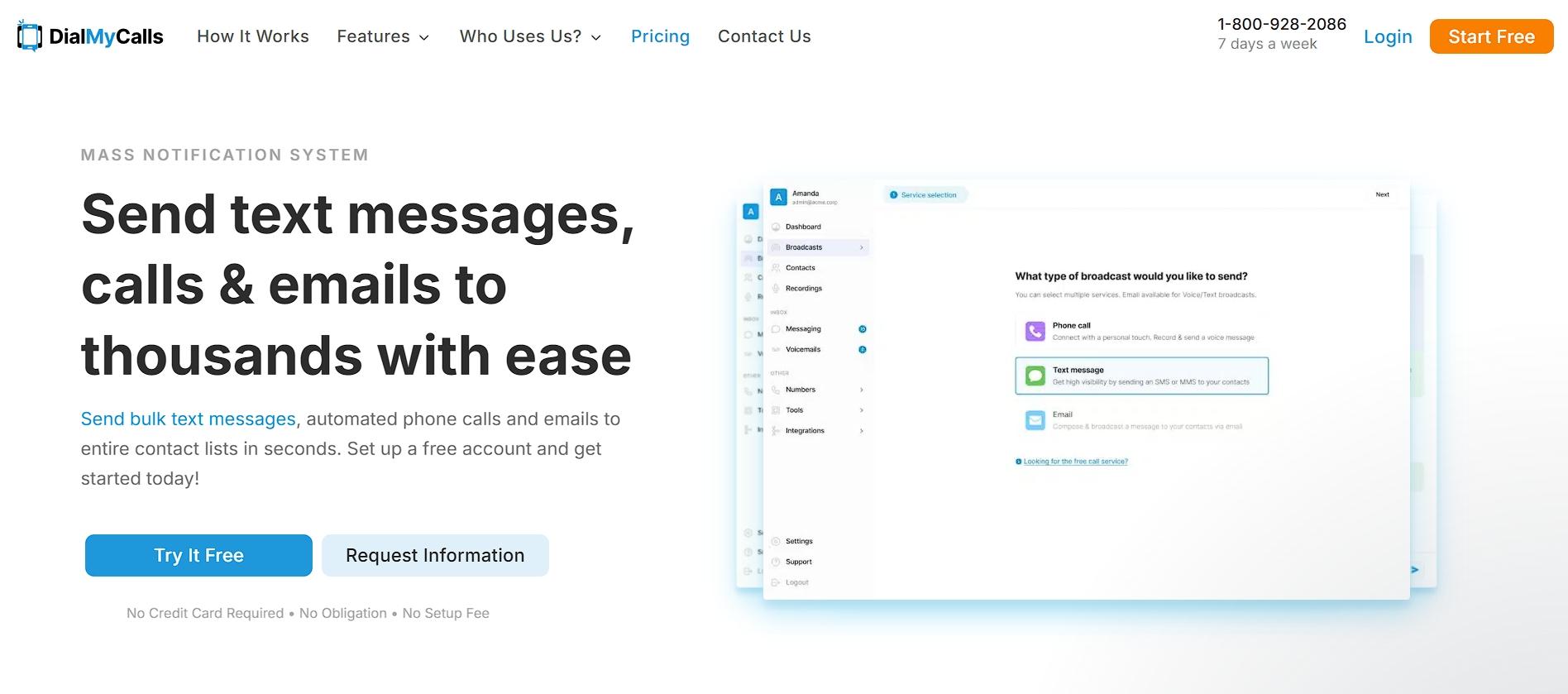
DialMyCalls offers a mass notification platform that lets you send bulk text messages, voice broadcasts, and emails to large contact lists from one dashboard.
It supports scheduling, two-way texting, and integration into existing workflows. That way, you can reach customers, subscribers, or teams quickly with alerts, promotions, or updates.
Key Features
- Mass text-messaging and voice broadcast options with scheduling and automated delivery.
- Two-way SMS, MMS support, and landline-enabled texting for broader reach.
- Contact management: import lists, segment contacts, use opt-in widgets, and manage opt-outs.
- Reporting and analytics: track campaign delivery, engagement, voicemails, and responses.
- API and integrations: connect with CRM or other systems for automating sends or syncing data.
Pros
- Low entry cost and free trial (25 free credits) make it easy to test.
- Flexible pricing models (“Credit Based,” “Contact Based,” and “Pay As You Go”) let you match usage to budget.
- Supports both SMS and voice messaging, giving multiple ways to reach your audience.
- Good mobile app support, enabling campaigns via phone or desktop.
Cons
- For very high message volumes or advanced features, cost can escalate or require a custom plan.
- Some users report that the interface involves multiple steps to send mass texts, which may slow things down when speed is critical.
- Primary user base is in the US/Canada, so international reach and pricing may be more complex for global brands.
Pricing
- DialMyCalls offers a free trial with 25 free message credits to test out.
- Monthly plans start at $34.99/month for 100 contacts for standard usage (includes features like toll-free number, SMS opt-in widget, and AI texting tools).
- Pay-as-you-go credit packs start at $15 for 200 credits (the minimum). 1 credit = 1 text of up to 160 characters per number or 30-second voice recording per number.
- Larger volume and custom enterprise plans require contacting sales for a custom quote.
3. Rosie: Best for Capturing Leads After Hours
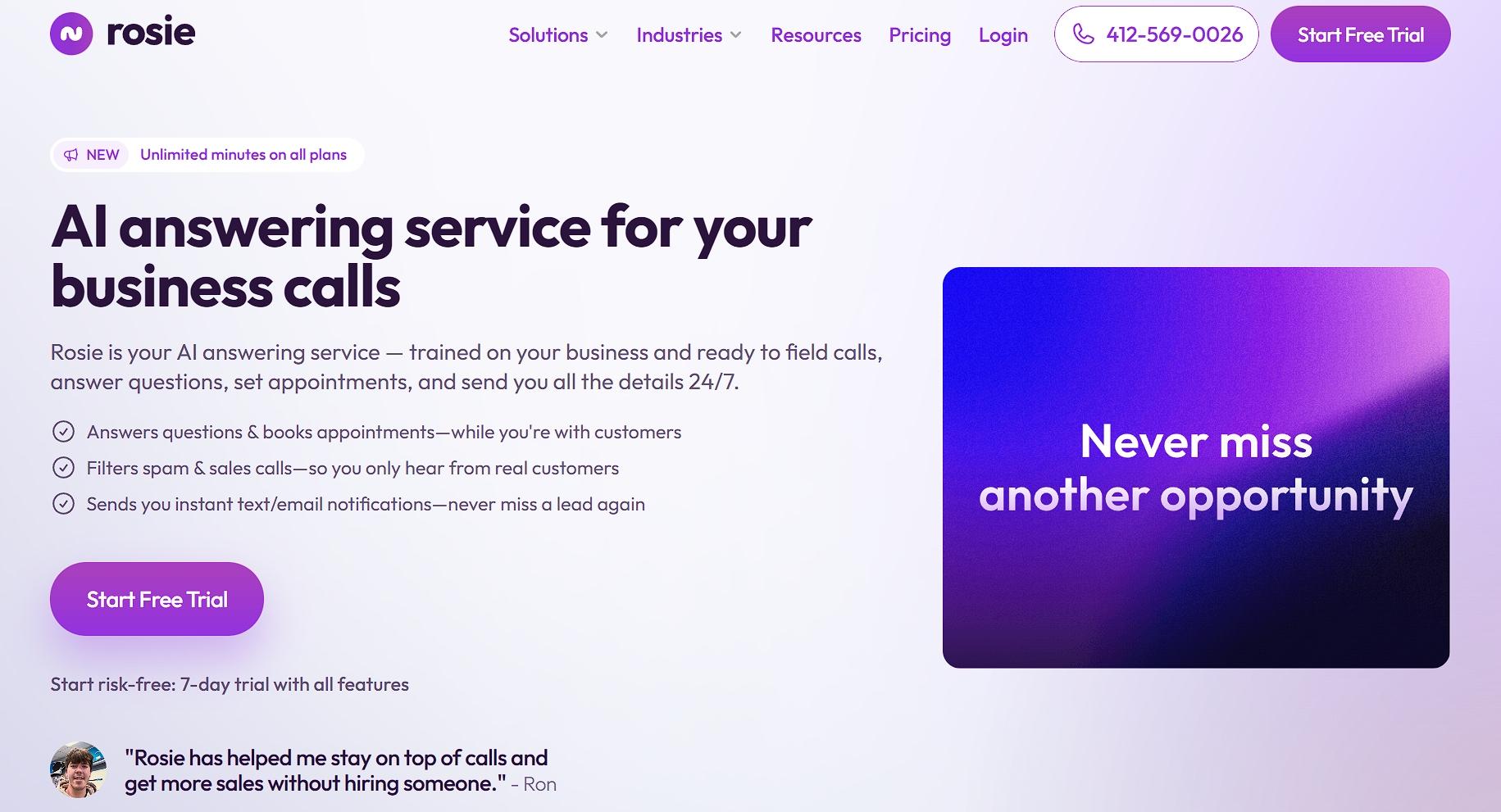
Rosie is an AI-powered answering service built to handle inbound calls, collect caller information, schedule appointments, and notify you instantly – all around the clock.
It’s designed for businesses that cannot afford to miss a call (or lead) and prefer a system that feels human but runs on AI.
Key Features
- 24/7 answering with unlimited minutes included in many plans.
- Call forwarding from your existing number.
- Custom agent name, greeting, scripted questions, and FAQ database tailored to your business.
- Call recordings, transcripts, notifications via email/text, and detailed message taking.
- Integrations with Zapier (1,000+ apps) for syncing call data into CRMs, calendars, etc.
- Spam-filtering and bilingual (English and Spanish) support in higher tiers.
Pros
- You avoid the cost and complexity of hiring full-time reception staff or using expensive 24/7 human call-centres.
- Setup is relatively fast and uses your existing business information to train the AI.
- Unlimited minutes in most plans make budgeting easier.
- Notifications, transcripts, and integrations let you act quickly on leads.
Cons
- While “unlimited minutes” is advertised, very high-volume users may still need custom pricing or risk being pushed into enterprise plans.
- AI may not handle extremely complex, domain-specific questions with the nuance a human expert might. Some users report limitations.
- For businesses with very high call volumes or requiring advanced routing, custom logic, or outbound calling, the standard tiers may not suffice.
Pricing
- Starting at $49/month for the “Professional” tier (entry-level).
- “Scale” ($149/month) and “Growth” ($299/month) tiers for added features like call transfers, appointment links, and more advanced training.
- A custom plan is available for multi-location or high-volume businesses. Pricing is negotiable.
- There’s also a 7-day free trial that includes all of Rosie’s features.
4. OptiMonk: Best for Converting Exit Traffic
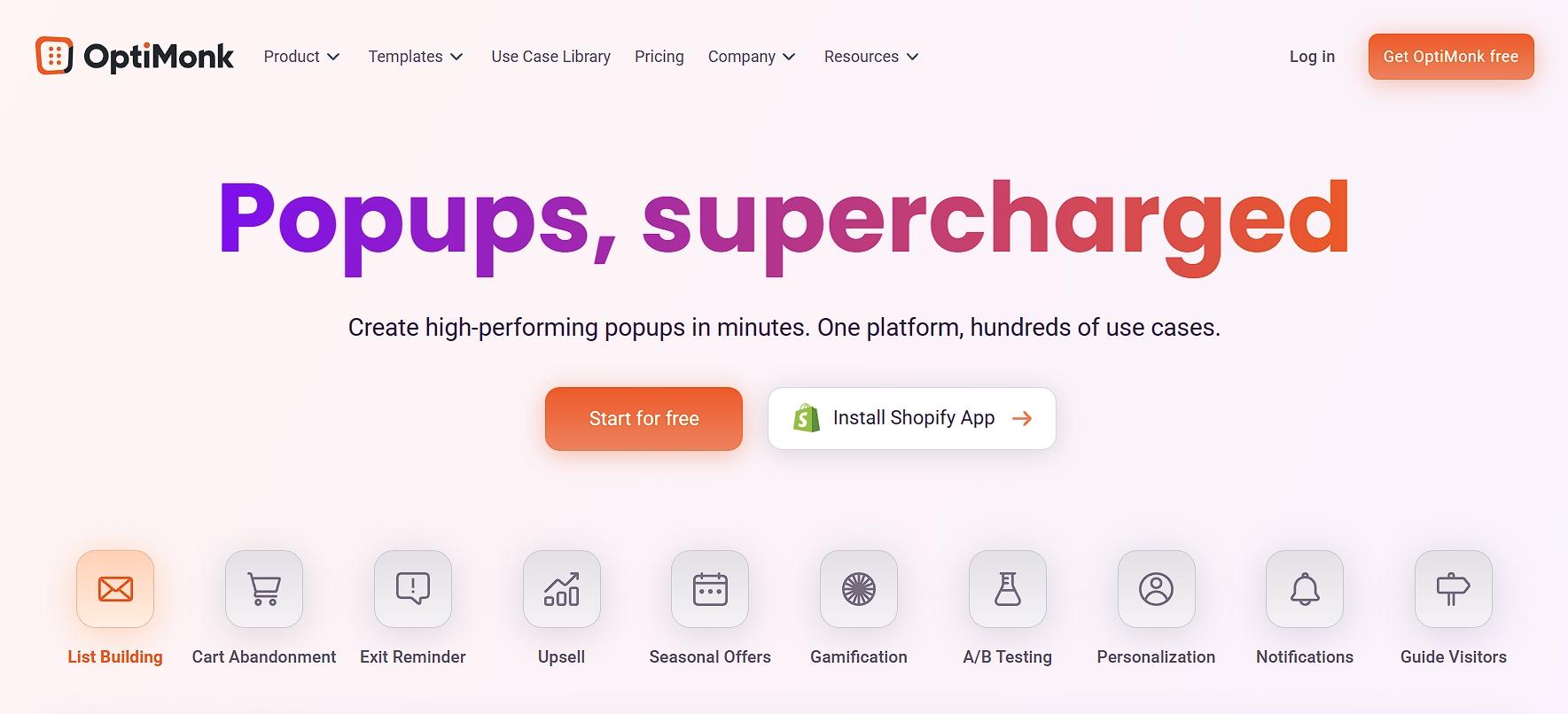
OptiMonk is a popup builder designed for ecommerce sites that want to turn more visitors into subscribers or buyers. It offers a drag-and-drop editor, a large library of templates, behavior-based triggers, and personalization tools to capture email/SMS leads, recover carts, and deliver offers at the right moment.
It works with major platforms (Shopify, WooCommerce, and WordPress) and supports features like exit-intent popups, upsell suggestions, and seasonal campaigns.
Key Features
- No-code visual editor plus pre-built template families for list building, cart abandonment, upselling, and gamification.
- Advanced targeting and personalization: behavior-based triggers, segmentation, smart tags, and visitor conditions.
- Built-in A/B testing to compare popups/offer variants and optimize conversion.
- Analytics and revenue-driven reporting: track which campaigns actually drive sales, not just sign-ups.
- Multi-platform support, mobile-friendly popups, custom domains, and integration with email/SMS tools.
Pros
- Works with minimal tech skills. Their templates and drag editor provide quick setup.
- Covers multiple use-cases (list growth, cart recovery, upselling, and seasonal promos) in one tool.
- Strong personalization and targeting allow popups to feel relevant rather than generic.
- Flexible pricing tiers with a free plan for small sites.
Cons
- Free and lower tiers have pageview and usage limits, which may restrict high-traffic sites.
- Some users say customization beyond templates can still require a learning curve.
- The cost jumps for very high volumes or dozens of domains, so you may need a custom plan.
Pricing
- The free plan supports one domain and up to 10,000 pageviews/month with full features.
- Paid plans start at $29/month (for the “Essential” tier) and go to $99/month (for the “Growth” tier) and $249/month (for the “Premium” tier), depending on pageview limits and domains.
- For very high traffic or multiple domains, you need to contact them for a custom “Master” plan.
5. Yotpo: Best for Turning Reviews Into Revenue

Yotpo is an ecommerce marketing platform built for online brands that want to convert customer content into trust and sales. It enables you to collect reviews, display user-generated content (UGC), and manage loyalty/referral programs, all in one place.
The platform supports major ecommerce ecosystems and helps you leverage customer voices as part of your growth machine.
Key Features
- Automated review requests and on-site review widgets that display product and site reviews.
- UGC capabilities: photo/video reviews, shoppable media galleries, and social push.
- Loyalty and referral program builder: points, rewards, referral tracking, and integrations with checkout flows.
- Analytics and insights: dashboards showing review performance, impact on conversions, and sentiment trends.
- Flexible product modules: you can purchase their “Reviews & UGC” and “Loyalty & Referrals” modules or bundle them into one package.
Pros
- Strong credibility boost: reviews and UGC help build trust with shoppers.
- Modular design: you can scale by adding modules as you grow instead of committing to everything upfront.
- Good integration: works with major ecommerce platforms and supports social/UGC elements.
- Reliable support: many users highlight responsive customer service.
Cons
- Pricing can become steep once your order volume or module usage increases.
- Some advanced features (such as custom analytics or a dedicated account manager) require enterprise-level plans.
- The interface and dashboard may feel heavy for smaller teams, especially when combining modules.
Pricing
- Yotpo offers a free entry-level option for review collection on small volumes (for instance, up to 50 orders/month).
- Paid plans vary significantly by the module and order volume.
- For example, the Reviews & UGC “Starter” plan starts at $79/month (for 500 orders) and the “Pro” plan at $169/month. The Loyalty & Referrals “Pro” plan starts at $199/month.
- For bundling both modules, pricing starts at $368/month for the “Pro” plan and $1,198/month for the “Premium” plan.
Final Thoughts
These five tools solve different problems, but they share one key thing – they address specific friction points that kill sales.
You don’t need all five. Pick the tool that fixes your biggest problem right now:
- If you’re spending heavily on ads and facing account bans, start with Uproas.
- If you’re looking to directly reach out to your audience, DialMyCalls might be worth exploring.
- If you’re losing leads after hours, test Rosie.
- If your bounce rate is high, OptiMonk and Yotpo make sense.
Was this news helpful?
 Yes, great stuff!
 I’m not sure
 No, doesn’t relate