

When Standard SEO Stops Working: A Growing E-Commerce Brand’s Guide to Enterprise SEO


When Standard SEO Stops Working: A Growing E-Commerce Brand’s Guide to Enterprise SEO
You can do everything right with basic SEO and still lose. Optimized product titles. Keyword-rich descriptions. A blog that actually gets updated. And yet, page one stays stubbornly out of reach while larger competitors seem to own it without breaking a sweat.
This isn’t a failure of effort. It’s a scale problem.
At some point, growing e-commerce brands hit a wall where the tactics that built early traffic can’t keep pace with the complexity of the business. Thousands of product pages, multiple storefronts, regional audiences, platform migrations – these create an SEO environment that standard approaches simply weren’t built for. That environment has a name: enterprise SEO.
This article breaks down what enterprise SEO actually means for e-commerce operators, whether your business is ready for it, and what separates a capable enterprise SEO partner from the dozens of agencies sending you cold emails every week.
What Makes Enterprise SEO Different From Regular SEO

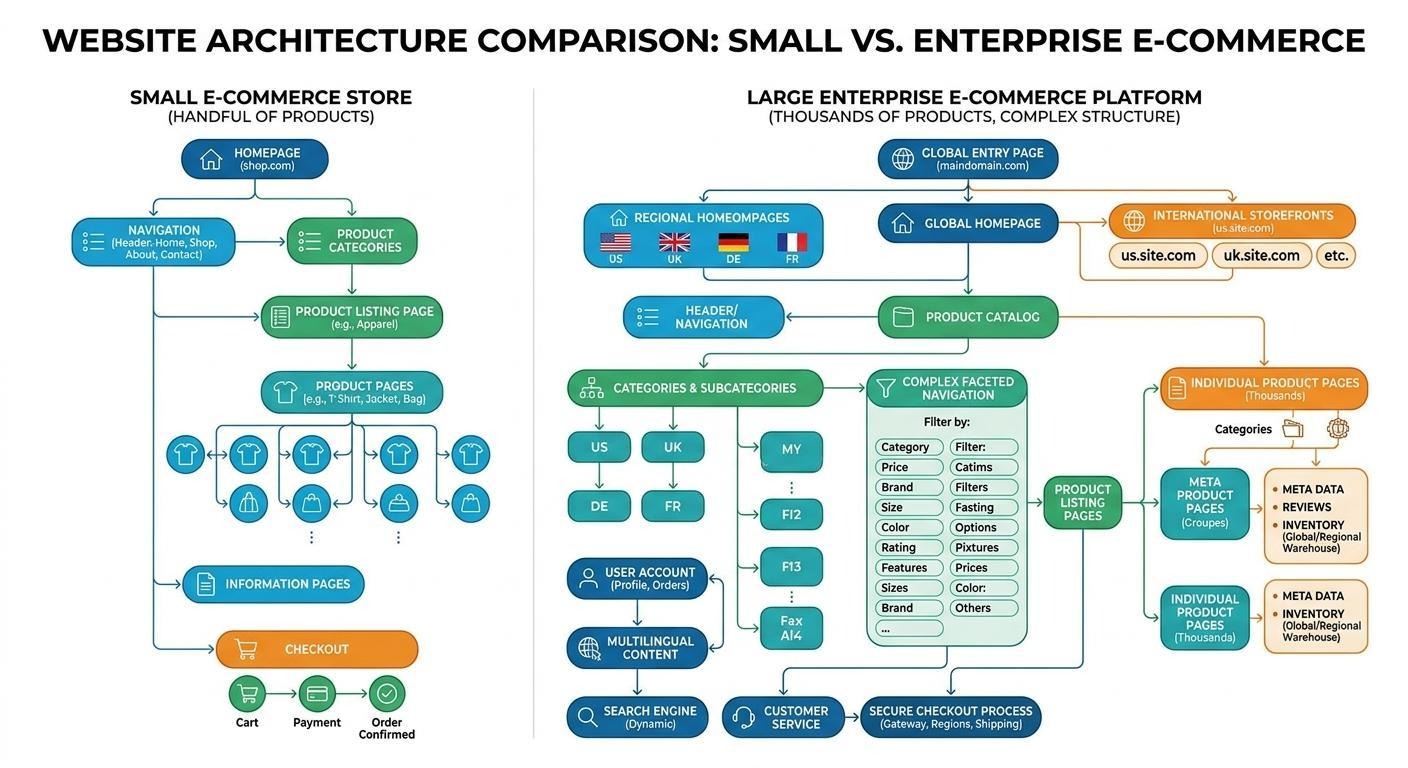
Enterprise websites often manage thousands of product pages across multiple domains – a scale that demands a fundamentally different SEO approach
Enterprise SEO isn’t just “regular SEO but bigger.” It’s a different discipline.
A standard SEO approach works well when you have a manageable site structure, a limited product catalog, and a team small enough that one person can oversee everything. The moment your catalog grows past several hundred SKUs, you start multiple regional sites, or your technical infrastructure runs on a legacy platform with years of accumulated problems, everything changes.
At enterprise scale, three areas get genuinely hard.
Technical SEO at scale. Crawl budgets become a real constraint. If Googlebot visits your site and has to choose between crawling your 80,000 product pages, your pagination chains, and your faceted navigation filters, it won’t get to everything. Site architecture decisions that feel minor on a 500-page site have significant consequences on a 500,000-page site. Core Web Vitals must hold up not just on a homepage but across massive product category pages loaded with dynamic content.
Content strategy at scale. Building topic authority across dozens of product categories requires a system, not a spreadsheet. Structured data – schema markup for products, reviews, availability – needs to be applied consistently and correctly across the entire catalog. One misconfigured template can affect tens of thousands of pages overnight.
Off-page authority and link building. Getting links at enterprise scale means digital PR campaigns, editorial placements, and coordinated outreach – not guest posts alone. The goal is building domain-level authority that lifts entire categories, not just individual pages.
There’s also a governance layer that most agencies ignore. Enterprise websites involve multiple departments: product teams, developers, legal, marketing, and sometimes regional country managers. Every SEO change goes through sign-off processes. Working with the best enterprise seo company means getting a partner who can navigate these layers without slowing your growth – someone who knows how to write technical specs developers will actually implement and how to communicate SEO priorities in terms that get budget approved.
According to data from TaylorScher SEO (2025), 43% of e-commerce traffic comes from organic Google search. That’s not a traffic source you want managed by a team that’s never dealt with site migrations, indexation gaps, or duplicate content across multiple storefronts. Search Engine Land’s enterprise SEO guide goes deep on governance models and technical foundations – it’s worth reading if you want to understand what a structured enterprise SEO program actually looks like internally.
If you’re still working on the fundamentals, the e-commerce SEO strategies covered in Sellbery’s SEO guide are a solid baseline before stepping up to enterprise-level execution.
The ROI Case for Enterprise SEO
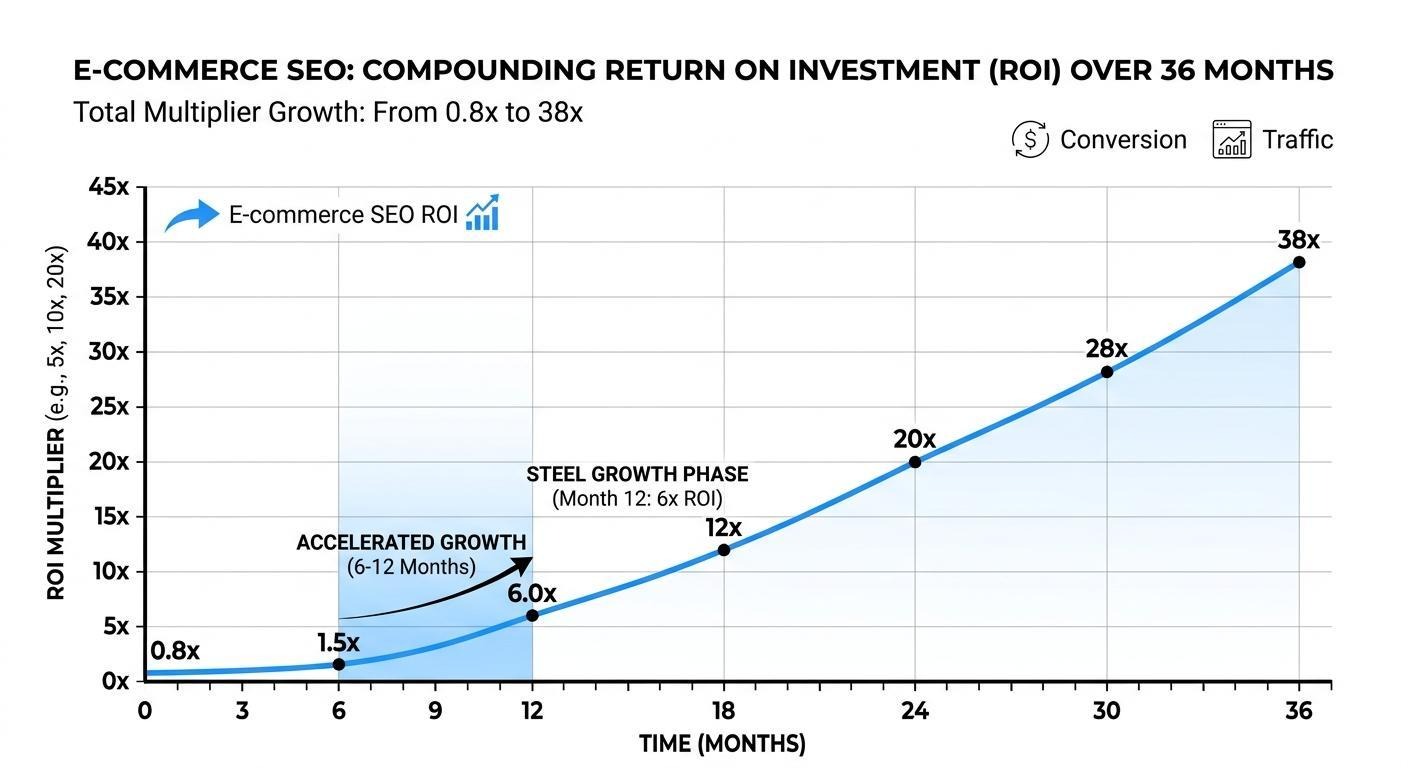
E-commerce SEO ROI compounds over time – reaching 5.2x at 36 months as content authority builds – First Page Sage, 2026
The most common objection to enterprise SEO is cost. Enterprise SEO budgets can reach $500,000 or more annually (SeoProfy, 2025). That’s a real number, and it deserves a real answer.
Here’s what the data shows. First Page Sage’s 2026 report, which analyzed 80 e-commerce clients from January 2022 through March 2025, found that e-commerce SEO delivers a 3.2x average ROI at 12 months, rising to 5.2x at 36 months as marginal costs decline. Specialty retail reached 4.2x at 12 months. By contrast, Google Ads delivers roughly 1.9x ROI over the same period. Organic search compounds. Paid search doesn’t.
The math gets more favorable the longer the horizon. And for enterprise brands with high customer lifetime values, even small percentage gains in organic traffic can represent significant revenue.
Now, the AI Overview question. Organic CTR dropped 61% for queries that trigger Google AI Overviews – from 1.76% to 0.61% – according to Seer Interactive data cited by DemandSage in September 2025. That sounds alarming. But the same data shows that brands cited within AI Overviews earn 35% more organic clicks and 91% more paid clicks compared to brands not cited. The brands that get cited are the ones with strong topical authority, well-structured content, and technical SEO that helps Google parse and trust their information. That’s precisely what enterprise SEO builds.
Enterprise SEO teams also rely on the best competitor analysis tools to track market share shifts, identify content gaps, and benchmark their authority against category leaders – giving them the competitive intelligence to prioritize the right opportunities rather than guessing.
BrightEdge, which works with 57% of the Fortune 100, documented how Meta doubled its monthly search traffic by applying enterprise SEO principles across its properties. That kind of result doesn’t happen through incremental keyword tweaks.
When Does a Growing E-Commerce Brand Need Enterprise SEO?
The honest answer: earlier than most brands think. Here are the signals that your current SEO approach has hit its ceiling:
- Your product catalog has grown past 500-1,000 SKUs and you’re managing dozens of category pages, each competing for similar keywords
- You’ve expanded into multiple regional storefronts or international markets with separate URLs, and you’re seeing cannibalization or indexation issues
- Your technical problems – duplicate content, crawl errors, thin pages, broken pagination – require a developer to fix, not just a plugin
- You’re spending $10,000 or more per month on Google Ads and want a scalable alternative that doesn’t reset to zero if you pause the budget
- You’re selling across Amazon, Shopify, Etsy, or your own DTC site simultaneously, and you’re not sure which signals are helping or hurting your authority
That last point is especially relevant for multichannel sellers. Selling across multiple platforms creates exactly the kind of fragmented digital footprint that enterprise SEO is designed to address – consistent brand signals, clear canonical structures, and content strategies that support discovery across channels.
SeoProfy’s 2025 data found that 54% of enterprise brands outsource their SEO rather than managing it entirely in-house. That’s not a sign of weakness; it’s a recognition that the discipline requires specialization that most in-house teams weren’t hired to provide.
Understanding how SEO fits into your broader growth playbook matters too. The piece on leveraging digital channels for growth is worth a read for sellers who want to see how organic search connects to a wider multichannel strategy.
What to Look for in an Enterprise SEO Company

Enterprise SEO demands coordinated work across technical, content, and data teams – the right agency acts as an extension of your existing team
The SEO services market hit $83.98 billion in 2026, up from $74.9 billion in 2025, according to Mordor Intelligence – with large enterprises accounting for 56% of total SEO software market share. There are a lot of agencies competing for that spend. Most of them will tell you what you want to hear. A few will actually deliver.
Here’s what to actually evaluate:
- Technical depth. Can they audit a site with 100,000+ pages and tell you which fixes will move revenue first? Prioritization matters more than exhaustive checklists. Ask for examples of technical roadmaps they’ve delivered for large sites.
- Content systems. Enterprise SEO isn’t about writing individual blog posts. It’s about building scalable content operations: templates, production workflows, internal linking systems, structured data at scale. Ask how they build content programs rather than individual pieces.
- Link building strategy. At enterprise scale, link building means digital PR, editorial placements, and coordinated outreach campaigns – not just guest posting. Ask specifically how they build domain-level authority, not just page-level links.
- Reporting tied to revenue. Rankings are a lagging indicator. Good enterprise SEO partners report on organic traffic to revenue-generating pages, assisted conversions, and market share in target keyword categories. If an agency leads with keyword ranking reports, push for more.
- Industry-specific experience. E-commerce SEO has different demands than B2B SaaS or local services. Product schema, review markup, category page architecture, site search optimization – these require people who’ve done the work before in competitive retail categories.
- Cross-functional communication. Your SEO partner will need to work with your development team, your content writers, and possibly your regional marketing leads. Poor communication is the most common reason enterprise SEO programs stall. Ask how they handle implementation roadblocks.
About 49% of companies use a hybrid in-house/outsourced model for SEO (SeoProfy, 2024), which means many enterprise brands are already doing some SEO work internally. The right agency doesn’t compete with your in-house team – they fill the gaps and bring the specialization that’s hard to hire for full-time.
For a broader view of how to align SEO with your overall marketing direction, Sellbery’s guide to digital marketing strategies covers the integration points well.
You can also use the Mordor Intelligence SEO market report to understand the scale of enterprise SEO adoption – helpful context when making the case internally for increased investment.
The Cost of Staying Where You Are
For e-commerce brands still running SEO the way they did when they had 50 products, the problem isn’t that what they’re doing is wrong. It’s that the competition has moved on.
Organic search isn’t a marketing tactic at enterprise scale – it’s infrastructure. The brands building authoritative, technically sound, content-rich sites today are the ones that will be cited in Google’s AI Overviews tomorrow. That’s not a metaphor; it’s how the ranking systems are evolving.
Check where organic traffic sits relative to your paid search spend. If the ratio is heavily skewed toward paid, you’re renting visibility instead of owning it. At some point, the cost of staying static outweighs the cost of scaling up your SEO approach.
The window to build that authority ahead of your competitors is still open. But it won’t be forever.
Was this news helpful?
 Yes, great stuff!
 I’m not sure
 No, doesn’t relate