



Top IT Asset Lifecycle Management Platforms: Comparing 6 Leading Vendors
Top IT Asset Lifecycle Management Platforms: Comparing 6 Leading Vendors
An IT asset lifecycle management platform is only as useful as its fit with how your team actually operates. Most IT departments already know they have gaps. A laptop goes untracked the moment someone leaves the company. A license renewal slips through because no one owns the spreadsheet. Asset data never quite matches what procurement or the ITSM system shows. What separates a team that runs a clean audit from one that scrambles through it usually isn’t effort. It’s whether the platform fits the environment.
The six platforms below solve different pieces of that problem, from global hardware logistics to infrastructure discovery to unified software and SaaS governance. Each one was checked against public documentation, verified user reviews, case studies, and directory listings before making this list. The breakdown below covers what each one does and who it’s built for.
At a Glance
- Workwize: Best for global IT asset lifecycle management
- Certero: Best for unified asset management across IT, software, SaaS, and cloud
- Firstbase: Best for global IT asset management
- Snipe-IT: Best for enterprise IT asset tracking without vendor lock-in
- Anunta: Best for enterprise desktop-as-a-service and managed endpoints
- Device42: Best for IT infrastructure discovery
Why This Category Matters
Spreadsheets and disconnected tools work fine until they don’t. A device goes untracked once someone’s working from a home office in another country. A software license quietly slips into overage because nobody caught the renewal. The cost of that gap shows up fast: wasted spend, a failed audit, or a security hole nobody meant to leave open.
The right platform keeps three numbers honest: asset utilization rate, software license compliance rate, and mean time to asset discovery and setup. That last one matters more than it sounds. A new hire waiting two weeks for a laptop because nobody could locate one in inventory isn’t really an onboarding failure. It’s an asset tracking failure.
The platform that fits your actual environment beats the one with the smoothest sales demo. That’s what separates a team that runs a clean audit from a team that’s still scrambling through one.
IT Asset Lifecycle Management Platforms Compared
Company details below are drawn from official websites and review platforms.
| Company | Years Operating | Headquarters |
| Workwize | Founded 2020 | Amsterdam, Netherlands |
| Certero | Founded 2007 | Undisclosed |
| Firstbase | Founded 2019 | Aberdeen, Scotland, and New York, NY |
| Snipe-IT | 13+ years | San Diego, CA |
| Anunta | Founded 2012 | Mumbai, Maharashtra, India |
| Device42 | Founded 2010 | West Haven, Connecticut |
Workwize: Best for Global IT Asset Lifecycle Management
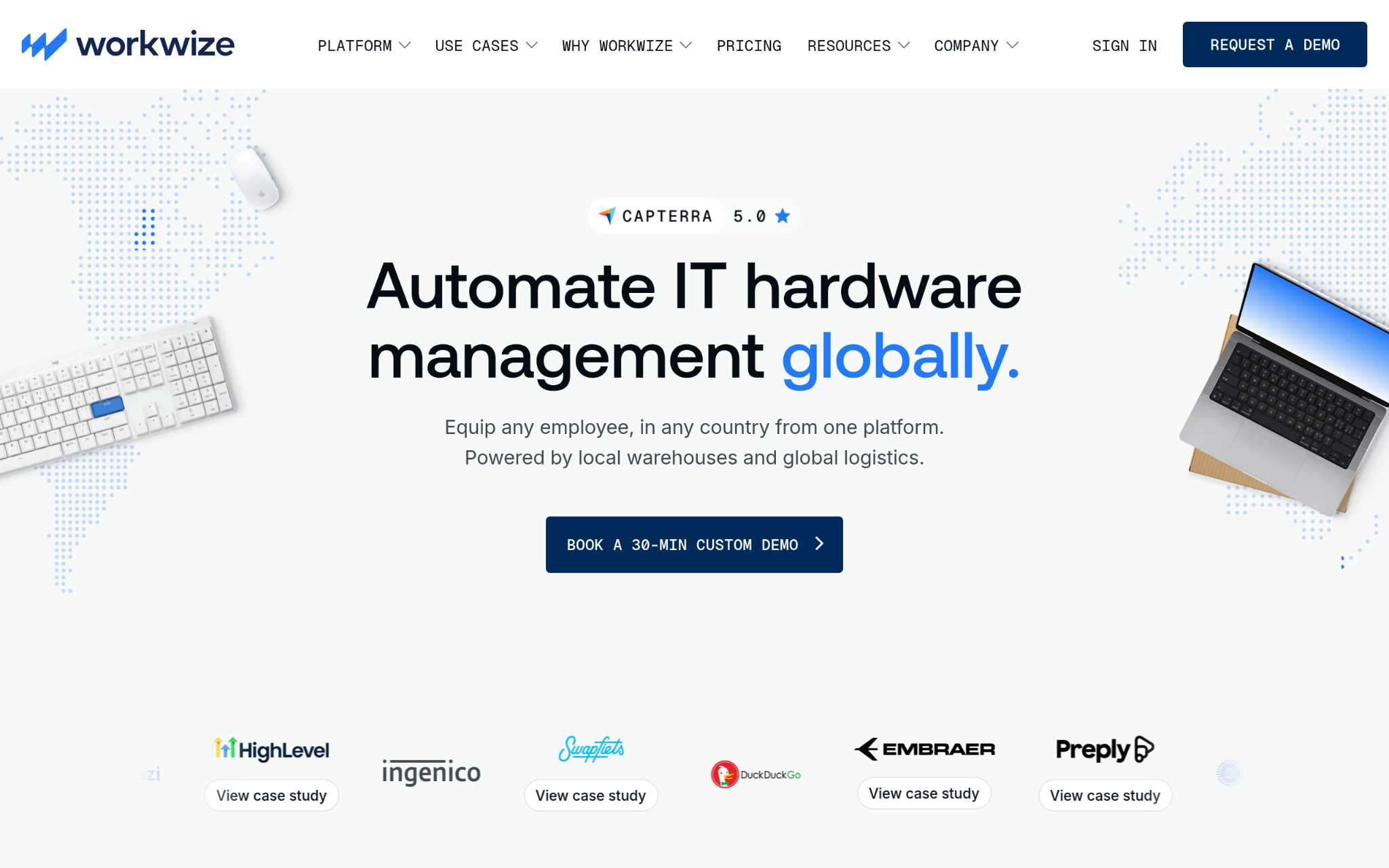
Workwize automates hardware logistics for globally distributed teams: procurement, deployment, tracking, retrieval, and disposal, across 120 countries. It connects directly to HRIS, MDM, and identity systems. Onboarding and offboarding workflows fire automatically, instead of requiring someone in IT to coordinate across departments by hand. Local warehouses and logistics partners get devices to new hires in 2 to 7 days in most regions. Workwize reports that IT teams using the platform save more than 80,000 hours a year, with device recovery rates reaching as high as 98%.
Why It Stands Out
Most vendors handle either the physical logistics of hardware or the workflow automation around it, rarely both at once. Workwize combines asset logistics, compliance tracking, and workflow automation into a single system. That’s an uncommon pairing for teams managing hardware across borders, and hard to replicate by stitching together separate point tools.
What Users Say
Reviewers consistently point to Workwize’s logistics reliability in international markets. They also highlight the time IT teams get back once manual coordination is replaced by automated workflows. The HRIS integration comes up often as the single feature that changed day-to-day operations the most. Device retrieval performance abroad is a recurring theme in the praise the platform gets.
Certero: Best for Unified Asset Management Across IT, Software, SaaS, and Cloud
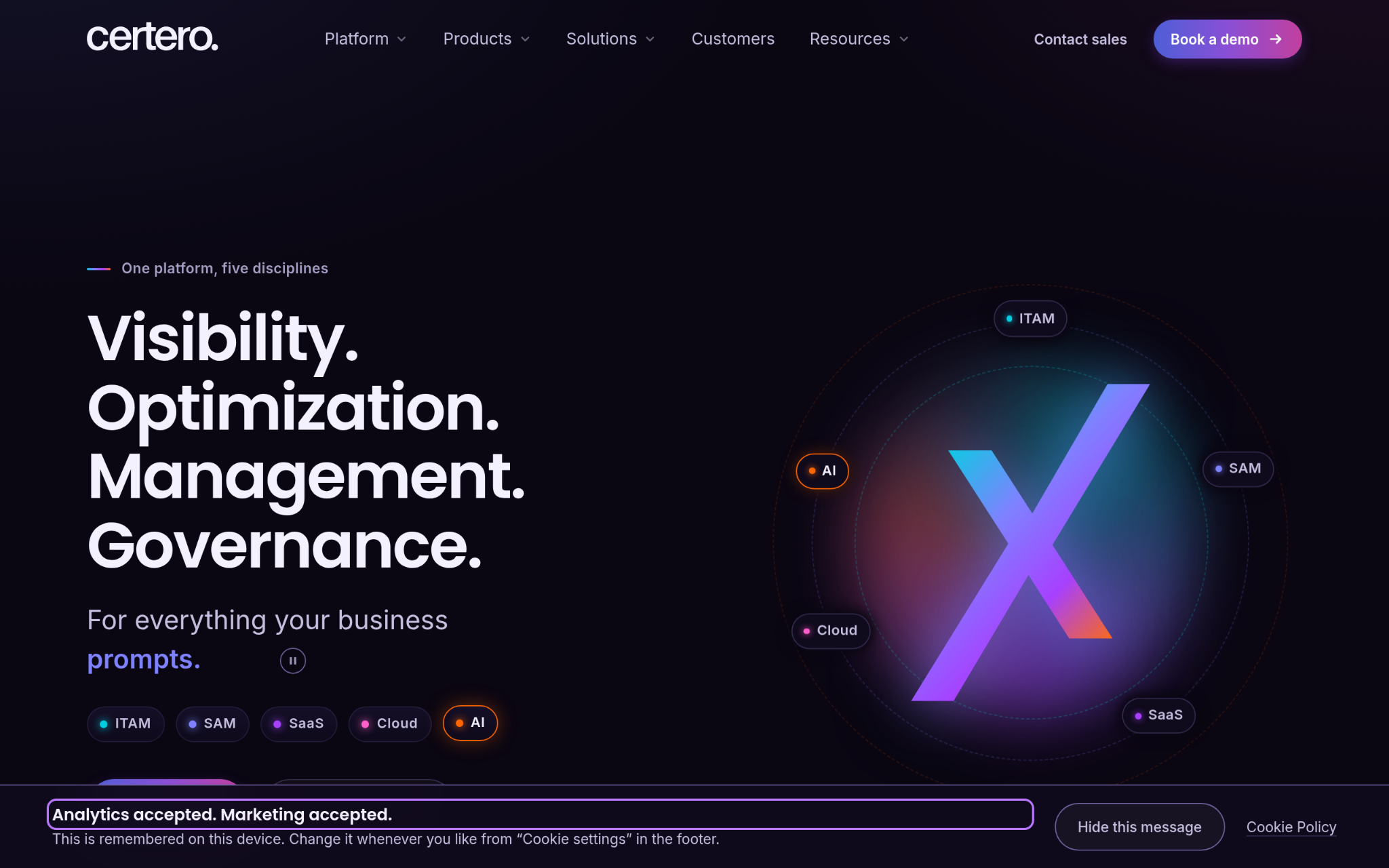
Certero is a privately held enterprise software company, founded in 2007. It covers IT asset management, software asset management, SaaS management, cloud management, and AI management inside one platform called CerteroX. Unlike vendors that assembled their platform through acquisitions, Certero built its system organically. The data model is shared across all five asset classes by design, rather than stitched together after the fact. Its Command Centre handles reporting. The discovery engine uses ten separate detection methods. Compliance enforcement runs largely on autopilot, through what the company calls compliance-as-code. Certero holds ISO 27001:2022 certification, Cyber Essentials Plus status, and FinOps Certified Platform status.
Why It Stands Out
Enterprise asset management often breaks down at the seams between tools: one system for software, another for SaaS, a third for hardware. Each keeps its own data, and the numbers never quite reconcile across them. Certero’s single shared data model removes those seams. It was also the only vendor to earn Customers’ Choice status in the 2024 Gartner Peer Insights Voice of the Customer report for SAM tools. That’s a third-party signal that carries real weight in a software evaluation.
What Users Say
Customers describe the unified data model as the reason they stay with Certero, not just the reason they signed up. Organizations in regulated industries, including NHS trusts and regional health systems, single out the governance and compliance tooling as especially strong. Teams that need every asset class managed in one place, without a separate integration project for each, tend to find this platform hard to leave.
Firstbase: Best for Global IT Asset Management
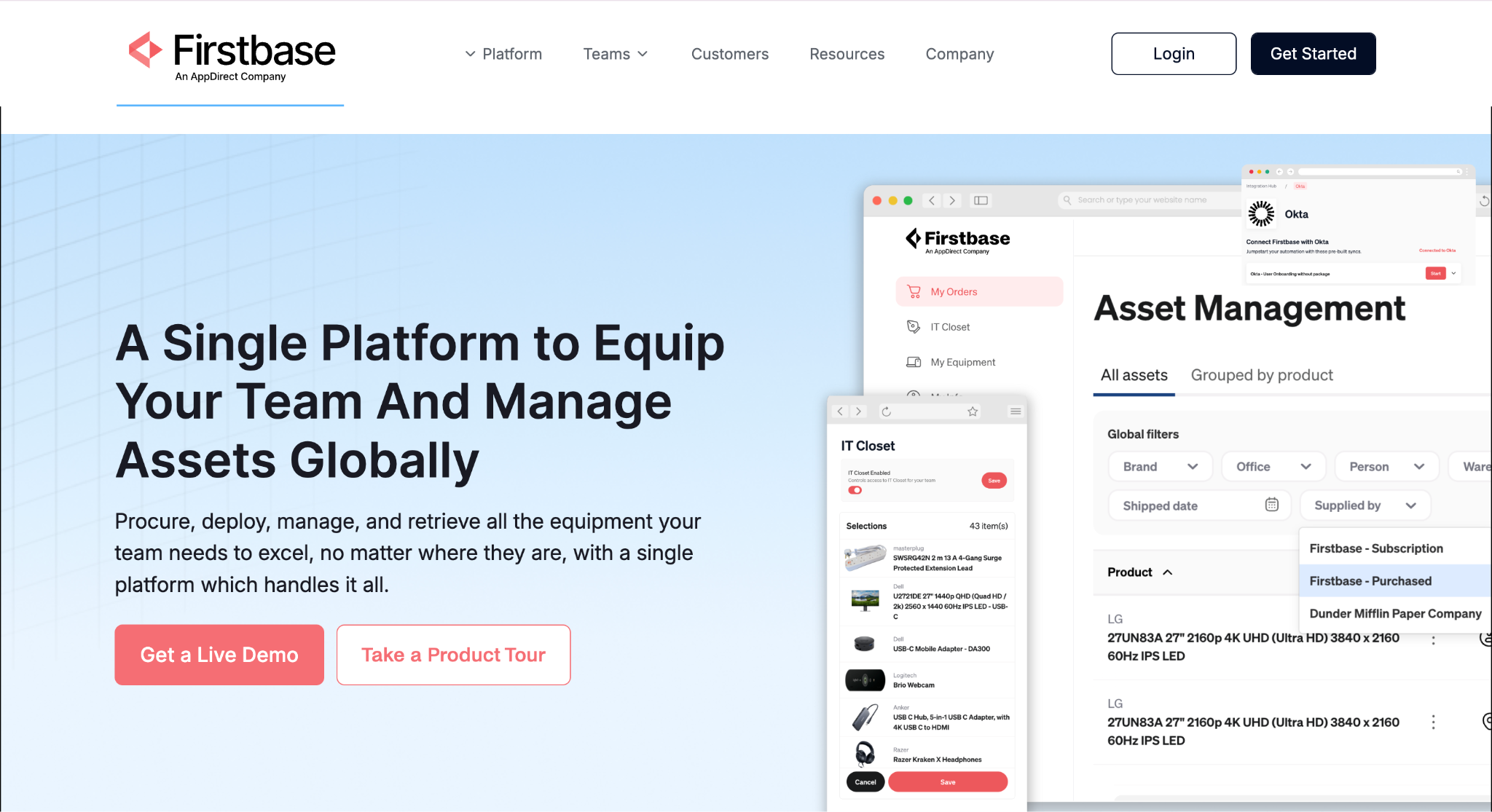
Firstbase handles procurement, device provisioning, inventory tracking, mobile device management, and asset recovery for distributed enterprises. It operates across 150-plus countries, with some capabilities reaching 190-plus. Equipment arrives pre-configured through zero-touch deployment. The platform keeps a full audit trail from the moment a device is procured to the moment it’s retired. Device retrieval rates run above 97%. Enterprise customers include Spotify, Cloudflare, and UiPath, and the company is backed by Andreessen Horowitz and Kleiner Perkins. AppDirect has since acquired Firstbase, adding distribution reach to the platform.
Why It Stands Out
Companies scaling into new markets often discover their existing asset tools have no real presence there, which turns expansion into a logistics problem overnight. Firstbase’s pre-stocked, pre-configured equipment model removes the delivery coordination that normally slows down international setup. That gets ahead of a compliance and logistics gap before it becomes a blocker.
What Users Say
Enterprise customers highlight how quickly Firstbase can deploy in a new geography, a useful edge for companies scaling a distributed workforce fast. The completeness of the audit trail gets singled out as a compliance strength by users at fast-growing tech companies. Some note the platform delivers the most value when used for full lifecycle management rather than as a point solution.
Snipe-IT: Best for Enterprise IT Asset Tracking Without Vendor Lock-In
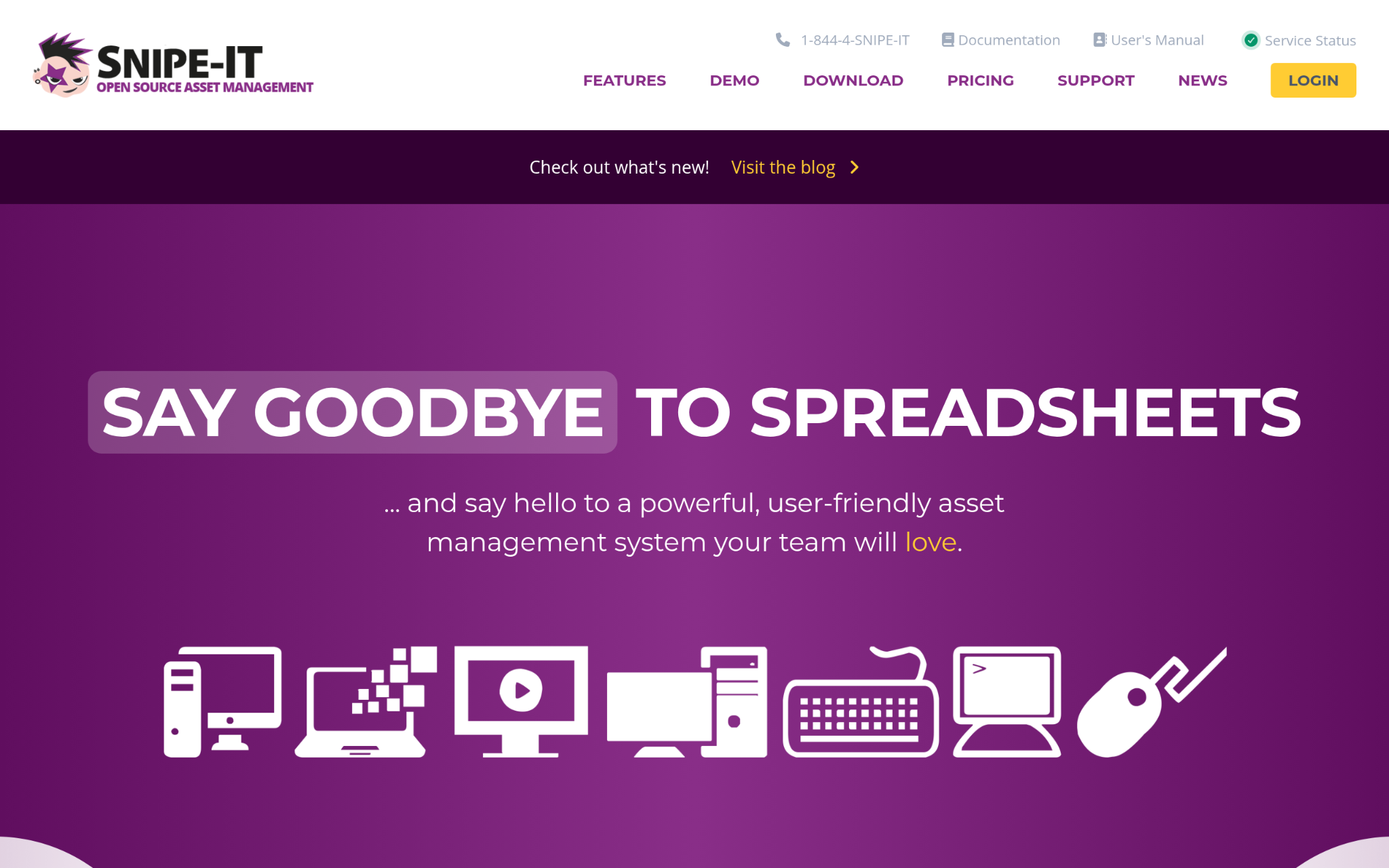
Snipe-IT is a free, open source IT asset management system built by Grokability, Inc., designed to replace spreadsheet-based tracking with a structured, automated system. It’s available as a self-hosted or cloud-hosted deployment and supports barcode scanning, a REST API, and user-level asset assignment. The platform has 13 years of operational history, and Grokability reports it now manages 21.7 million assets across 10.4 million users. The freemium pricing model keeps it accessible, and because it’s open source, there’s no vendor lock-in to plan around.
Why It Stands Out
Organizations that want a reliable, security-conscious asset tracking foundation without committing to an expensive proprietary platform tend to land on Snipe-IT. More than 330 contributors maintain the codebase, and the infrastructure runs across 12 data centers. The company backs it with a 99.99% availability guarantee, giving enterprise buyers a level of confidence that open source tools don’t always offer.
What Users Say
Reviewers repeatedly mention how much simpler Snipe-IT’s setup is compared to heavier enterprise platforms. The REST API’s flexibility for custom integrations comes up often as a strength. Some users note that advanced reporting still takes manual work to get right. It’s a platform that has earned loyalty through reliability rather than flashy features.
Anunta: Best for Enterprise Desktop-as-a-Service and Managed Endpoints
Anunta is an enterprise software company focused on digital workspace delivery: desktop-as-a-service (DaaS), managed endpoint services, and desktop management across cloud environments. Founded in 2012 and headquartered in Mumbai, the company has migrated more than 1 million remote desktop users across private, public, and hybrid cloud environments. Its proprietary platforms, DesktopReady, CloudOptimal, and EuVantage, together cover VDI migration, modern desktop management, and cloud spend analysis. Anunta has placed in the Gartner Magic Quadrant for DaaS four years running, a track record that reflects real staying power in the category.
Why It Stands Out
As physical hardware becomes less central to how people actually work, the harder problem shifts to managing the virtual desktop environment itself. Anunta built its business around that shift, focusing on workspace lifecycle management rather than hardware tracking alone. That fits how a lot of hybrid workforces actually operate today.
What Users Say
Users point to Anunta’s migration experience as its clearest strength, especially for large-scale VDI transitions where mistakes are costly. Feedback consistently notes strong technical depth from the delivery teams. Some reviewers mention that adopting Anunta’s proprietary platform ecosystem takes real setup investment upfront.
Device42: Best for IT Infrastructure Discovery
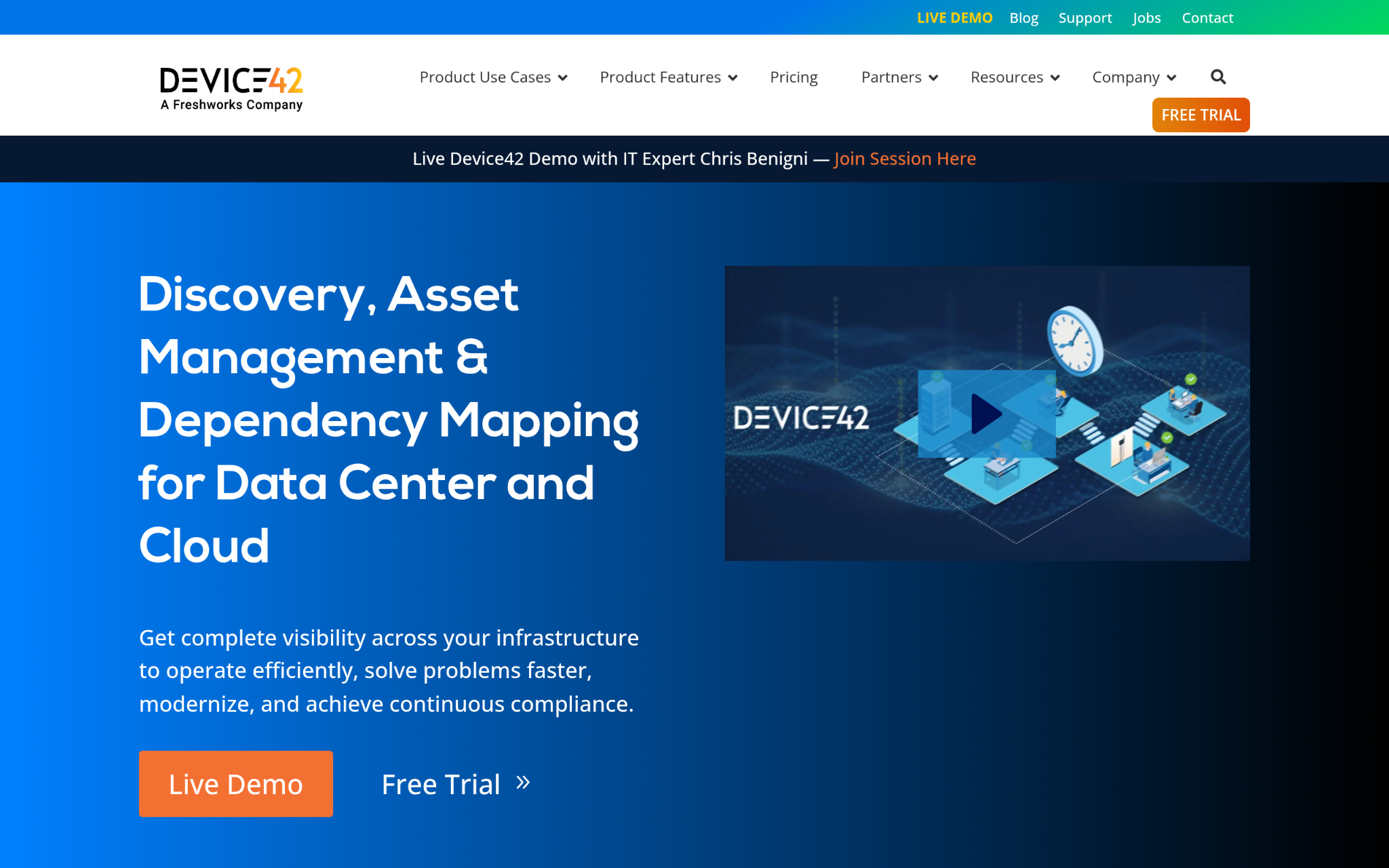
Device42 is an IT infrastructure discovery and asset management platform built for hybrid environments, covering everything from legacy on-premise systems to modern cloud containers. Its agentless discovery approach maps a company’s full infrastructure, including application dependencies, without deploying agents across thousands of endpoints. The platform is deployed in more than 70 countries and feeds a near real-time configuration management database (CMDB), with built-in AI for natural language queries. Device42 reports that customers resolve outages 10 times faster on average and see a 4.8x return on investment. Freshworks acquired Device42 for $230 million in May 2024.
Why It Stands Out
Infrastructure invisibility is the problem that surfaces at the worst possible time, usually mid-outage, when nobody can say what depends on what. Device42’s agentless discovery model, paired with more than 30 integrations including ServiceNow and Ansible, keeps that picture current without requiring manual inventory work.
What Users Say
Reviewers consistently name dependency mapping as the feature that mattered most during cloud migrations and data center consolidations. Teams running complex hybrid environments say Device42 sees the full picture where other tools only capture part of it. Many view the Freshworks acquisition as a good sign for continued product investment.
How This List Was Built
Picking the right platform takes more than comparing feature lists. Here’s the framework used to evaluate all six.
Building the Initial List
The starting list came from software directories, review aggregators, industry analyst coverage, and vendor comparison sites. Every entry was checked against public documentation: company profiles, product pages, and customer case studies. Platforms without clear public evidence of enterprise deployment were cut before scoring began.
Narrowing the Field
Unverified or thinly documented platforms were removed early. The remaining candidates went through a review pattern analysis that looked at consistency in how customers described outcomes, not just star ratings. Platforms with a thin or heavily promotional review profile didn’t make the cut. Only vendors with real review volume and genuine operational context advanced.
Checking the Claims
Every stated capability was checked against what actual users reported. When a vendor claimed an outcome (faster deployment, higher retrieval rates, license savings), that claim was checked against review language, case study data, and independent analyst commentary. Claims that existed only in vendor marketing, with no outside corroboration, were noted and weighted down accordingly.
Weighing Authority and Recognition
Recognition signals fed into the evaluation too: analyst placements, industry awards, mentions in enterprise IT publications, and evidence of original research or product development. Platforms that showed up consistently across independent, authoritative sources scored higher confidence than platforms relying only on self-reported numbers.
Confirming Lifecycle Management Depth
Each platform was checked for direct evidence of lifecycle management work specifically. That meant dedicated service pages covering hardware and software asset management, and verified reviews from IT asset managers and procurement leaders. It also meant case studies showing real outcomes like cost avoidance, audit readiness, or device recovery performance. Generalist tools without clear depth in lifecycle management didn’t make the final six.
How to Choose the Right Platform
Match the platform’s actual strengths to your operational reality. The most feature-rich option on paper isn’t automatically the right one for your environment.
- Industry experience. Look for a platform with a track record in your specific environment, whether that’s distributed hardware, hybrid infrastructure, or software license compliance. A vendor that has solved your kind of problem before closes the gap between what a demo promises and what the platform actually delivers.
- Lifecycle coverage. Map the platform against your full asset lifecycle: procurement, deployment, tracking, retrieval, and disposal. A tool that only covers half of that leaves gaps that manual work, and budget, will end up filling.
- Pricing structure. Find out whether pricing is quote-based, per-device, or seat-licensed, and model it against your current asset count and where it’s headed. A surprise true-up cost or overage fee is exactly what a good platform is supposed to prevent.
- Reporting depth. Ask specifically how the platform reports on asset utilization rate, software license compliance rate, and audit readiness score. If the reporting is thin, proving the platform’s value to leadership turns into a manual project of its own.
- Compliance and standards. Confirm the platform supports ISO 19770, ITIL, SOX, GDPR, and whatever audit standards apply to your industry. Compliance gaps have a habit of surfacing during the audit itself, which is the worst possible time to find them.
Final Take
Managing the IT asset lifecycle across a distributed organization is a hard problem, and the right platform changes how well a team handles it. Workwize leads on global hardware automation, Device42 leads on infrastructure discovery, and Certero leads on unified software and SaaS governance. Each platform solves a different piece of the puzzle, so the right choice comes down to where your own operational gaps run deepest. As more organizations spread across borders and cloud environments, the need for lifecycle automation and audit readiness is only going to grow.
Was this news helpful?
 Yes, great stuff!
 I’m not sure
 No, doesn’t relate