


MusicCreator AI Review: An Analytical Perspective

Read an in-depth MusicCreator AI review: explore features, benefits, limitations, and its role in reshaping music production with AI.
Introduction
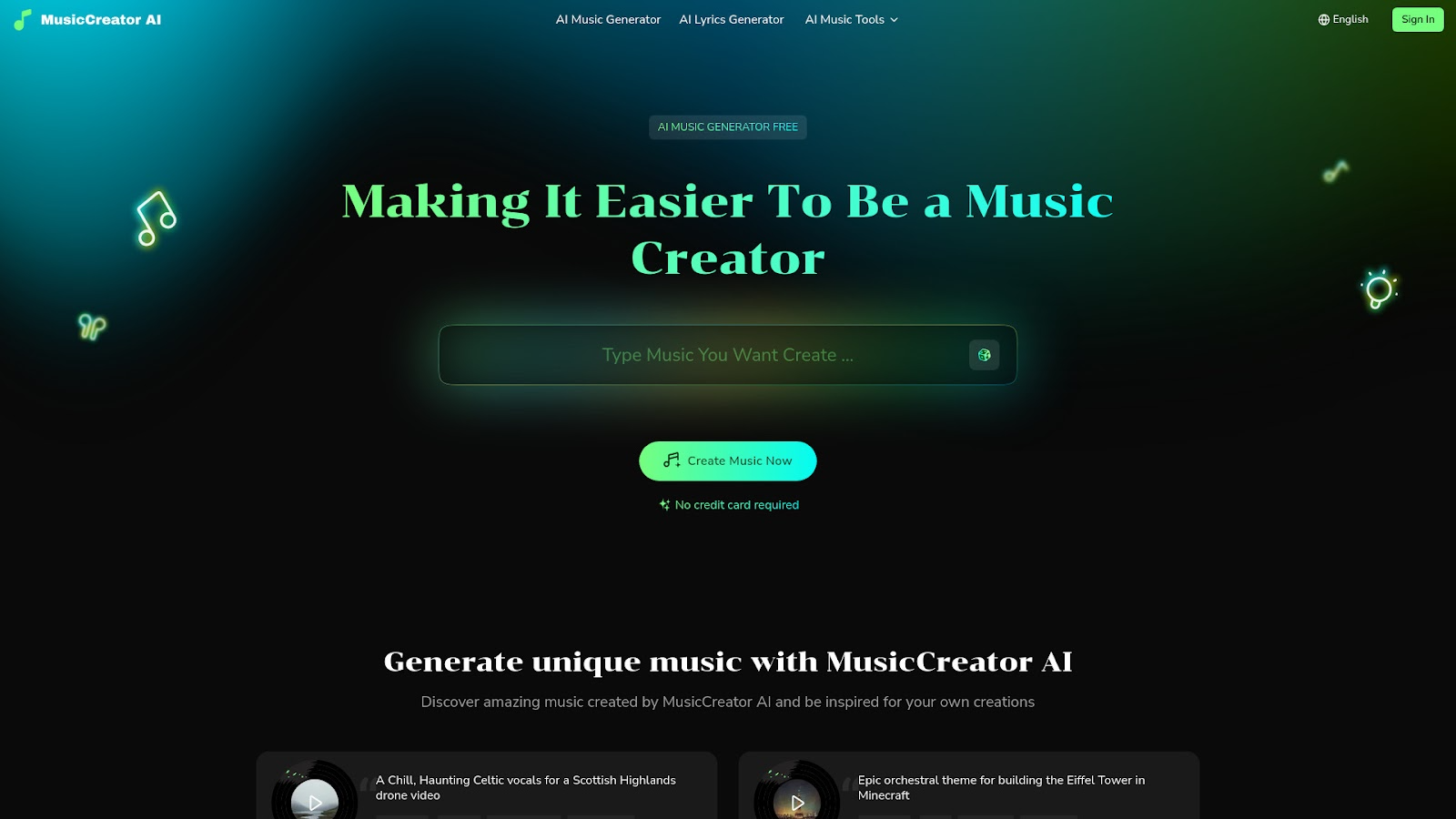
The development of artificial intelligence in the music industry is progressing at a remarkable pace. Among the growing number of tools available to creators, MusicCreator AI presents itself as a structured, reliable, and technically advanced platform. This review examines its purpose, functional design, advantages, shortcomings, and broader implications in a market increasingly shaped by automation.
The Underlying Purpose
Democratizing Access to Music Production
The primary rationale behind MusicCreator AI lies in accessibility. Traditionally, music production has demanded significant financial investment and specialized skills. This platform seeks to eliminate those requirements, enabling individuals without prior training to produce coherent and usable compositions.
Reducing Technical Barriers
By automating complex processes, it offers users the ability to focus on creative direction rather than on technical details. The integration of Text to music illustrates this approach effectively, as words themselves can be transformed into structured, harmonized audio output.
Functional Characteristics
Core Features
- Lyric-to-Melody Conversion: Words or short texts are processed into song structures.
- Genre Adaptability: Users can specify musical direction, from electronic to acoustic.
- Automated Mastering: Final tracks are refined to ensure professional playback.
- Web-Based Operation: The platform is accessible without installation, simplifying usage.
Workflow Process
Users input their content, define the preferred style, and generate audio. The process is iterative, permitting multiple adjustments. While simple in execution, it reflects a sophisticated design philosophy that prioritizes both speed and adaptability.
Advantages
Accessibility and Efficiency
MusicCreator AI reduces the time between idea and realization. What once required studio expertise can now be executed in a matter of seconds. For professionals, this means faster prototyping. For novices, it means participation in music creation previously unavailable to them.
Royalty-Free Output
Another benefit is ownership. Tracks generated by the platform are royalty-free, a crucial factor for commercial application in areas such as marketing, podcasts, and online video production.
Limitations
Creative Constraints
Despite its strengths, the system cannot fully replicate the emotional nuance inherent in human performance. Outputs occasionally display a degree of uniformity, reflecting the boundaries of algorithmic generation.
Dependence on Input Quality
Results are highly dependent on the clarity of user input. While the text to music system can generate melodies from minimal prompts, vague or poorly structured text may lead to unsatisfactory results.
Target User Groups
Independent Creators
For musicians working outside traditional studio environments, the tool provides an affordable and practical solution for generating drafts and ideas.
Digital Content Producers
Influencers, educators, and small enterprises can employ the platform to produce distinctive soundtracks, enhancing engagement and branding.
Writers and Poets
The text to music feature allows those focused on language to expand their work into an auditory dimension, effectively extending creative expression into new formats.
Market Implications
Shaping the Creator Economy
The availability of tools such as MusicCreator AI signifies a transformation in the creative economy. Barriers to entry are diminishing, and the definition of “musician” is expanding to include individuals who rely primarily on technology.
Competitive Dynamics
As more platforms enter the market, differentiation will depend not only on technical sophistication but also on how effectively tools like this align with cultural and commercial demands. MusicCreator AI positions itself as a serious participant in this evolving landscape.
Conclusion
Balanced Assessment
MusicCreator AI is neither a replacement for traditional musicianship nor an experimental novelty. It represents a calculated integration of artificial intelligence into the creative process. Its strengths—efficiency, accessibility, and adaptability—are significant. Its weaknesses—limited emotional depth and potential uniformity—are notable but not disqualifying.
Final Observation
For individuals seeking a dependable AI-driven solution for generating original music, MusicCreator AI delivers. Its application of text to music demonstrates both the potential and the limitations of artificial intelligence in creative industries. Ultimately, the platform illustrates how technology continues to reshape artistic practice in measured, tangible ways.
Was this news helpful?
 Yes, great stuff!
 I’m not sure
 No, doesn’t relate