


Ferndesk Review: How AI Is Transforming Documentation for Teams

Ferndesk Review: How AI Is Transforming Documentation for Teams
Every SaaS company faces the same painful cycle. You write help articles when your product launches. Features change. Documentation falls behind. Customers cannot find answers. Support tickets pile up. Your team scrambles to update articles they forgot existed.
This cycle repeats endlessly because traditional help centres are passive. They store content. They do not maintain it. The burden of keeping everything current falls on teams already stretched thin with higher priorities.
Ferndesk approaches this problem from a fundamentally different angle. Rather than giving teams better tools to write documentation manually, it provides an ai-native documentation tool that actively maintains your help centre by connecting to the sources of truth across your product and support ecosystem.
This review explores how Ferndesk works, what it actually delivers, and whether it solves the documentation maintenance problem that plagues growing SaaS companies.
The Documentation Problem Ferndesk Solves
Every organisation struggles with documentation to some degree. The challenge is not recognising its importance. Everyone agrees that documented processes and well-maintained help centres improve customer satisfaction and reduce support costs.
The problem is maintenance. Creating initial documentation takes effort but feels achievable. Keeping that documentation accurate as your product evolves month after month is where teams fail consistently.
Software products ship updates weekly. Button labels change. Features get renamed. Workflows shift. Each change potentially invalidates multiple help articles simultaneously. Nobody tracks which articles need updating when code ships.
Support tickets reveal the consequences clearly. Customers follow outdated instructions and get confused. They contact support about problems your documentation should have prevented. Your team answers the same questions repeatedly because the help centre cannot keep up.
Traditional knowledge base platforms like Zendesk Guide, Intercom Articles, and Help Scout Docs offer places to store documentation. They provide editors and search functionality. But they remain fundamentally passive. Content sits unchanged until someone manually updates it.
This gap between documentation creation and documentation maintenance explains why most SaaS help centres are outdated. Teams want better guides but cannot invest the ongoing time required. The underlying economics of manual maintenance need to change.
How Ferndesk Approaches Documentation Differently
Ferndesk built its platform around a core insight. Help centre tools should maintain documentation, not just store it. The platform centres on an AI agent called Fern that connects to your actual sources of truth across your product ecosystem.
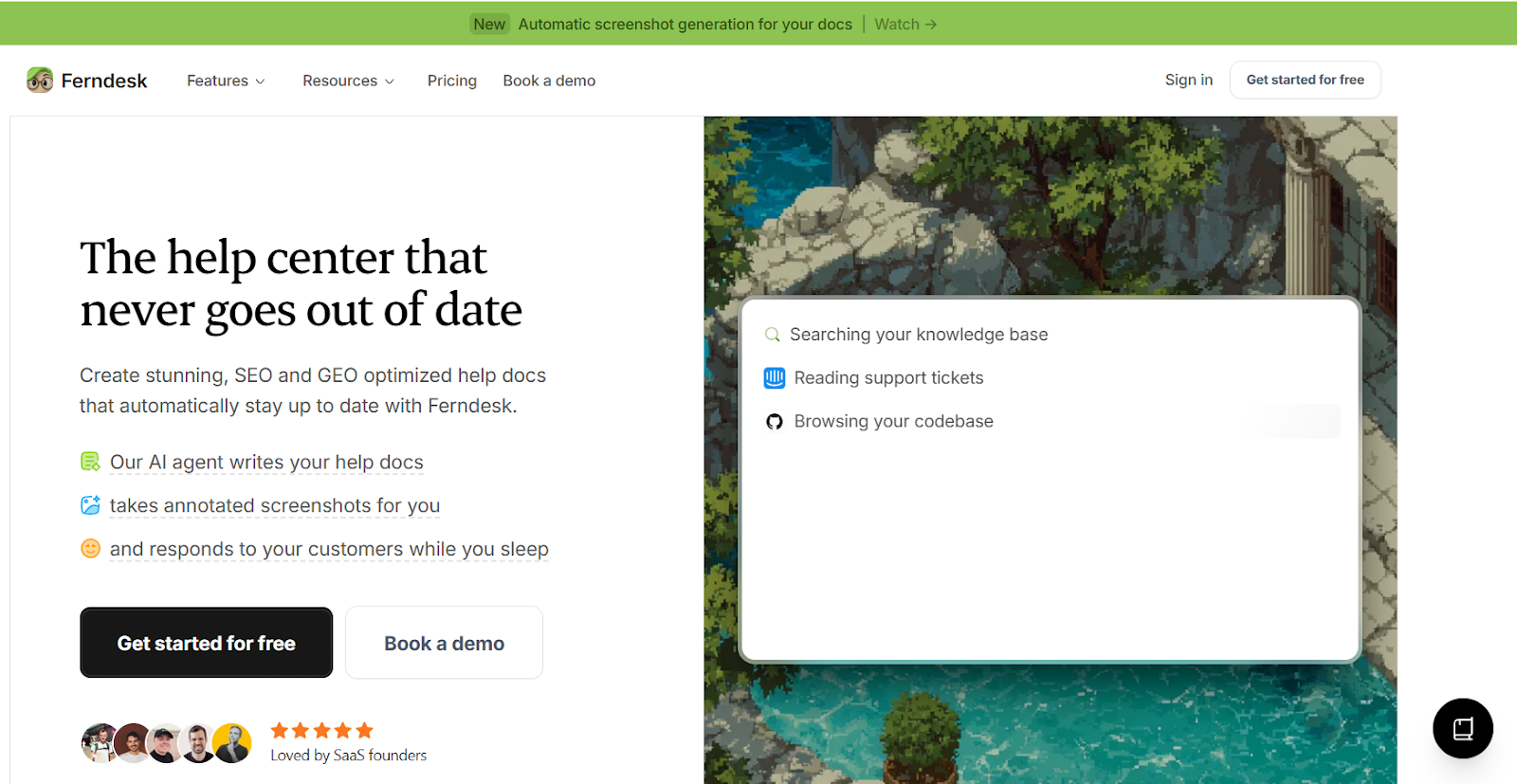
Fern reads your codebase on GitHub to detect product changes as they ship. It analyses support tickets from platforms like Intercom, Help Scout, Crisp, and Missive to identify what customers are actually asking. It pulls context from internal documentation in Notion and Linear. It monitors changelogs, launch videos, and release notes.
Every week, Fern audits your help centre against these sources. When something is outdated, missing, or needs updating, it drafts changes for your review. You approve, tweak if needed, and publish.
This approach inverts the traditional documentation workflow. Instead of relying on someone to remember which articles need updating after every product change, the AI monitors changes proactively and surfaces documentation gaps before customers complain.
You instruct Fern through natural conversation. Need to replace every mention of a phone number across your help centre with a support portal link? Tell Fern. It identifies every affected article, drafts the changes, and presents them for review. What previously took hours of manual searching and editing happens in minutes.
The result is a help centre that evolves alongside your product rather than falling progressively further behind.
Support Ticket Analysis: The Standout Feature
The support ticket analysis capability deserves special attention. This feature alone justifies exploring Ferndesk for many SaaS teams. It eliminates the guesswork from documentation strategy entirely.
Ferndesk analyses up to 1,000 support tickets monthly on the Startup plan and up to 5,000 on the Team plan. It identifies recurring questions that your documentation is not answering. Patterns emerge showing exactly where customers struggle and what content is missing.
Instead of guessing what to document next, you see precisely which knowledge gaps generate the most support volume. Fern then drafts articles addressing those specific pain points using context from your product and existing documentation.
This data-driven approach transforms documentation from a reactive chore into a proactive support strategy. Every article created addresses a demonstrated customer need rather than an assumed one. The connection between documentation effort and support ticket reduction becomes measurable.
RightMessage, a personalisation platform managing a 30,000-word help centre, experienced this firsthand. Their documentation had fallen out of date across multiple product overhauls. After implementing Ferndesk, code commits now drive documentation updates automatically. As their founder noted, when they change a label on a button, Fern proactively modifies the docs without manual intervention.
Automated Screenshot Generation
Keeping screenshots current in documentation is a notoriously painful problem. Your UI changes. Screenshots across dozens of articles become outdated overnight. Finding and replacing them manually consumes hours nobody has.
Ferndesk has recently launched automated screenshot generation specifically designed to address this. Fern does this by browsing your actual application using credentials you provide during setup, navigating to the relevant screens, and capturing fresh screenshots with annotations highlighting key UI elements, all automatically. You simply review the draft and publish.
This capability eliminates the tedious process of hunting down every screenshot affected by UI changes. For teams shipping frequently, this automation alone saves hours of manual work each month.
The feature represents a meaningful advancement because screenshot staleness is one of the fastest ways documentation loses credibility. A customer following a guide with screenshots that do not match their screen immediately loses confidence in the entire article.
Content Auditing That Prevents Staleness
Weekly automated audits represent another capability that traditional platforms simply lack. Fern scans your help centre against recent product changes, support conversations, and internal updates to identify what has become stale.
When your engineering team pushes code changes affecting user-facing features, Fern flags relevant documentation for review. Renamed a feature? Changed a workflow? The AI identifies which articles reference outdated information and drafts corrections.
Broken links get detected automatically. Content gaps surface before they generate complaints. Articles that no longer match your product’s current state get flagged with specific recommendations for updates.
This proactive maintenance means documentation debt stops accumulating silently. Problems get caught weekly rather than discovered months later by frustrated customers. The steady drip of small updates prevents the overwhelming documentation overhaul that teams typically face.
The Help Centre Itself
Beyond AI capabilities, Ferndesk provides a fully functional customer-facing help centre that holds its own against established platforms.
Design customisation gives granular control over branding. Logos, colour palettes, layouts, and custom domains make your help centre feel like part of your main website rather than a third-party add-on. Custom subfolder hosting is available on the Team plan, allowing your help centre to live at yourcompany.com/help.
SEO and AEO optimisation comes built in. Articles are structured for discovery through search engines and AI chatbots like ChatGPT. Your documentation surfaces where customers actually look for answers.
Page speed is notably fast. Articles load in milliseconds, improving both search rankings and customer experience.
Built-in analytics show how customers interact with your help centre. Which articles perform well, where readers drop off, and what search queries return no results all inform content improvement decisions.
Customer feedback collection lets readers rate articles directly. Positive and negative signals guide prioritisation.
An embeddable self-service widget allows customers to search your knowledge base directly within your product. They ask questions in plain language and get instant AI-powered answers without leaving your app or submitting tickets.
Multilingual support enables help centre translation into multiple languages. The Startup plan includes two languages while the Team plan includes five, with additional languages available.
Private help centres with authentication are available on the Team plan. Magic links, SSO, and JWT options protect internal or premium documentation behind login requirements.
Integrations and Migration
Ferndesk connects with the tools SaaS teams already use daily. Support platform integrations include Intercom, Help Scout, Crisp, Missive, Gmail, and Fernand. Discord integration analyses community threads for documentation gaps. GitHub integration enables codebase monitoring. Linear integration allows creating articles through @mentions directly. A custom API endpoint accommodates additional tools.
One-click migration from existing help centres preserves your links and SEO rankings. Moving from Intercom, Zendesk, Crisp, Help Scout, or Fernand happens without breaking existing URLs or hurting search performance. This removes the migration fear that keeps teams on outdated platforms.
A Chrome extension lets team members update documentation from any browser tab, reducing friction for quick edits and corrections.
Practical Benefits for Teams
Time savings represent the most immediate benefit. Ferndesk customers save 20 hours a month on support and documentation on average, according to the company. Tristan Roth, founder of ISMS Copilot, reports doing in five minutes what previously took an hour. Emmet Cooke, founder of Pixelflow, confirms saving at least 20 hours monthly.
Support ticket volume decreases as documentation quality improves. Customers find accurate answers through self-service rather than contacting your team. Each deflected ticket saves time and money while improving customer experience.
Consistency improves when AI structures and updates documentation systematically. Tone, formatting, and accuracy remain uniform across your entire help centre.
Onboarding accelerates for both customers and new team members. Accurate documentation means new users find answers independently. New support staff reference reliable guides rather than outdated articles.
Knowledge retention improves as institutional information transfers from people to documented form. Employee departures no longer create knowledge emergencies.
Pricing and Plans
Ferndesk offers three pricing tiers designed for different team sizes and needs.
The Startup plan at $39 per month includes AI article drafting, up to 10 AI-published articles monthly with additional articles at $0.50 each, analysis of up to 1,000 support tickets, two languages, two collaborators, and 10+ integrations.
The Team plan at $99 per month adds unlimited AI publishing, up to 5,000 support ticket analysis, five languages, up to five collaborators, private help centres, and custom subfolder hosting.
The Enterprise plan at custom pricing includes everything in Team plus SSO (SAML), SCIM provisioning, priority support, custom integrations, white-glove onboarding, and unlimited team members.
All plans include a 7-day free trial with no credit card required.
Considerations Before Adopting
No tool solves every problem perfectly. Understanding limitations helps set appropriate expectations.
AI-generated documentation requires human review before publishing. Fern produces quality drafts but not polished finished articles every time. Plan for editorial oversight in your workflow.
The platform suits SaaS companies with frequently changing products most naturally. Businesses with stable products that rarely update may find less value in automated maintenance.
Ferndesk is relatively new compared to established platforms like Zendesk and Intercom. This means active development and responsiveness to feedback, but some teams prefer battle-tested solutions with longer track records.
Is Ferndesk Right for Your Team?
Ferndesk suits SaaS companies that ship frequently and struggle to keep documentation current. If manual maintenance has failed despite good intentions, AI-powered automation may provide the breakthrough your team needs.
Companies drowning in support tickets about topics that should be documented will see the most immediate impact. The ticket analysis alone can transform your help centre’s effectiveness within weeks.
Teams without dedicated technical writers benefit particularly. Ferndesk fills the documentation role that most startups cannot afford to hire for.
If your documentation debt has grown overwhelming, Ferndesk offers a practical path forward. The AI works through existing content systematically, flagging and fixing issues you might never find time to address manually.
Final Verdict
Ferndesk represents a genuine shift in how SaaS companies can approach customer documentation. The AI-native approach solves the maintenance problem that traditional platforms ignore entirely. Proactive auditing, support ticket analysis, automated screenshot capture with annotations, and AI-powered article drafting deliver meaningful value beyond what manual processes can achieve.
The platform is not magic. Human oversight remains essential. But the balance of effort shifts dramatically from creation and maintenance to review and refinement. That shift makes comprehensive, accurate documentation achievable for teams that previously could not keep up.
If outdated help articles are generating support tickets your team answers repeatedly, Ferndesk deserves serious evaluation. The documentation maintenance problem is real, expensive, and now solvable. Your customers deserve help content that matches the product they actually use today.
Was this news helpful?
 Yes, great stuff!
 I’m not sure
 No, doesn’t relate